Wednesday, August 8, 2018

From Basilica to Mosque to Museum


Without doubt the Hagia Sophia - Ayasofya in Turkish - is the most famous building in Istanbul. "Hagia Sophia" comes from the Greek and means "Holy Wisdom". Built in 537 AD during the Byzantine Empire it is also one of the oldest buildings in the city. It started out as a Greek Orthodox Christian patriarchal basilica, was later converted into an Ottoman mosque and has served as a museum since 1935 when it was secularized. (Warning: this is a very photo-heavy post)


We visited the Hagia Sophia on our second day in Istanbul, after we had seen the Blue Mosque - just across from the Ayasofya - the day before. I'm glad that we did it in this sequence, because this basilica converted mosque converted museum pretty much blew me away.


The interior with its famous dome and huge nave holds a serenity that couldn't even be disturbed by the many people who came here. I felt very small when I entered and was immediately fascinated by the many chandeliers that cast a warm light into the interior.

But before we ventured further we walked up the switchback ramp to the upstairs galleries. I loved the worn stone slabs shining with age.


Both the downstairs narthex and the galleries have beautiful ceilings, and everywhere you can notice the age of the building. Restoration work is continuously going on here. And look at those gorgeous columns!


But the crème de la crème are the mosaics.

They simply took my breath away. I will spare you my raving over them and just post pictures of them, leaving them to your own judgment. And if you're not into mosaics, just scroll down.


Let's look up one more time and then go down again at the end of the gallery.


While I loved the mosaics and spent a very long time on the galleries, my favorite feature of the Ayasofya was downstairs - the chandeliers. They were added during the Ottoman Empire. Pure eye candy and I was drooling over (well, under) them.


Eventually - reluctantly - we left; but there are so many beautiful things to discover outside as well.


Of course we can't forget the Ayasofya cats... this is just one of them.


It is beautiful at night as well, especially with the blue fountain in the foreground.


We just had to climb up to the roof terrace of our hotel to see the beauty of it.


Sunday, August 5, 2018

An Image and Its Story - July 2018


Even though I had taken so many pictures in July it was really easy to pick that one photo for this post. It reflects the friendliness and generosity we encountered with the Turkish people.


We had just spent the afternoon in Kaymakli Underground City in the Cappadocia area in central Anatolia. It was hot and we felt a light snack and some freshly pressed juice would be just the ticket. Then we saw this woman making gorgeous potato chip sticks. She cut an entire potato in a long spiral, then broiled it to turn it into a "potato spiral chip" on a stick. It was super delicious and just the right thing. She didn't speak much English, but was delighted that we had made the effort to learn a few words in Turkish.

I had forgotten to take a picture and came back when I saw her making one for another customer. I only wanted to photograph the display spiral chips, but she called at me and hold the stick up so that I could take a clear picture of it and her. It was such a lovely gesture - and so typical for the friendliness and generosity of this country's people. It has made this photo my very favorite one of our trip to Turkey.


Friday, July 27, 2018

Respecting a Different Religion


Where to start telling you about Istanbul? This city is so rich in history, so old and so full of ancient buildings and sites. That alone is almost overwhelming.

So let me begin with the building next to our hotel - about two minutes away. The Blue Mosque is one of the most popular touristic sites in Istanbul. Its correct name is Sultan Ahmed Mosque (in Turkish Sultan Ahmet Cami) after Sultan Ahmed I. during whose rule the mosque was constructed between 1609 and 1616. It still functions as a mosque where the muezzin calls for prayer five times during the day.

We got our first real glimpse of it on our first night in the city from one of the many roof top restaurants.


Most of the mosque was under construction when we were there, but we were still able to get into it and see the few parts that were open to the public at that time. We first entered the big courtyard or forecourt from where we could admire the beautiful architecture of the mosque.


I especially loved the ceiling in the arcades around the courtyard.


In order to be allowed inside the mosque you have to follow the dress code - women have to cover their heads and shoulders and clothes should fall beneath the knee; men had to wear long pants. Kaefer and I both had our scarves with us, but for those who hadn't there were free and freshly laundered coverings to borrow for both women and men. You also have to remove your shoes.


Then we stepped inside.

It was simply amazing. The mosque's walls are lined with handmade, hand painted ceramic tiles - just imagine all the work! The dominant color is blue, but there are so many more shades to discover.


Most designs are some sort of flowers with the tulip being the most popular one. Wherever we looked there were these tiles - on the walls, along the arches and in the ceiling of the domes. The hundreds of lamps bathed them in a beautiful warm light and gave the entire mosque an almost magical and very peaceful atmosphere.


The "non-tile" parts of the interior are just as beautiful even if not quite as amazing. I love the simple elegance of the arches.


Unfortunately the main dome and some of the "side" domes were under construction, so we were only able to just see a very small part of the interior of the mosque. I can only imagine how amazingly beautiful the entire mosque must be.

The prayer area, however, was open to men who wanted to worship. There were signs to please respect this area and don't take any photos. And what did some of the men do? They stepped into the prayer area, walked around the entire place as if they owned it, with their cell phones on a selfie stick, taking photos. I got so mad when I saw it. But what really ticked me off completely was a young guy who entered the women's prayer area - a much smaller area closed off with a barrier! - with his selfie stick phone. I was fuming.

What is so freakin' difficult about respecting the rules of a different religion in its place of worship? Why does someone has to be so rude? If someone is not able to respect the rules and customs in a different country then please stay home. Or at least don't visit their place of worship. I simple can't understand this total disregard and I certainly can't stomach it.

Those inconsiderate tourists overshadowed the visit to the mosque, but what I remember of it is mainly its beauty and its peacefulness.

When we left the mosque through the gate we saw the Hagia Sophia right opposite the Blue Mosque. Another stunning building that I will tell you about later.


And in the evening, from the roof top terrace of our hotel, we enjoyed the view of this stunning place with its six minarets.


Thursday, July 19, 2018

A Different World


Some of you may have noticed that I haven't visited you in some time. I didn't post much either - in fact, the last post was a scheduled post that I wrote some time back in June.

The Geek, Kaefer and I spent three wonderful weeks in Europe and Asia. At the beginning of the year we received the invitation to the wedding of the Geek's cousin - I wrote about him and his then-girlfriend in this post. The two had decided to tie the knot and since his bride is Turkish and they both live in Istanbul the wedding took place in Istanbul. A wonderful reason for us to spend a week in this fascinating city and another week further East in Turkey on the Asian continent.


Even though I grew up with Turkish friends - Germany has a large population of Turks - I had never been to Turkey before and I was excited to finally go to this country. Weeks before our flight I learned some basic words in Turkish. I wanted to be able to say "thank you" (teşekkürler) and "good morning" (günaydin) because I know how many doors are opened when you make the effort to just speak a few words in a country's language. My favorite word is "görüşürüz" (see you). While in Istanbul many people speak German or English, further inland a knowledge of either these languages becomes rather rare.


After one week in Istanbul we rented a car to drive across the Bosporus and into Asia where most of the country is located. I was a bit nervous about this trip, but there was absolutely no need. Turkey is a country with an extremely friendly and also generous population. On top of that we felt very safe wherever we went.


We traveled a country that calls itself the "largest museum of the world" - everything here has a very long history and everywhere there are ancient sites and buildings. There is a lot of tradition, at the same time this is a modern country. The muezzin calls to prayer several times a day and covered women talk on their cell phones. Over and over again it was the people who really amazed me, their friendliness, their humor, their openness about Erdoğan (we arrived two days after the election) and their wish just to communicate with us.


I didn't really want to leave after two weeks, but there was another country we had planned to visit.

In that country this language is spoken:


The only word I know in this language is "sláinte" - a very useful word, though.

You need it when you drink this:


Thankfully they also speak (sort of) English in Ireland even though Irish is the national and first official language. All the signs are both in Irish and English and sometimes with no English translation at all... 


Other than their British neighbor Ireland is a proud member of the EU, their currency is the Euro and they are very pro-European. They are also very proud of their own country and their traditions, and the battle for their independence from Britain is still very present in the people's mind. Oh the people - they, too, are so friendly. Everybody is ready to help you and they are great story tellers. They are immensely proud of their long history, and at the same time this is a very modern country.

Plus, they have Turkish barbers...


We spent a week in Ireland touring the country - everything is so close by - and we loved it. But the highlight of our trip definitely was the time spent in Turkey.

It was a different world. When it was time to leave I said goodbye with a very heavy heart. Arriving back in the US felt like landing on a foreign planet. I've always known that I'm a European at heart and always will be - you really can't just shed 40 years of living there - but now I also painfully miss my old continent.


Sunday, July 1, 2018

An Image and Its Story - June 2018


One day when I was working in my garden in front of the house I noticed some funny little "bumps" on some of the lavender stalks. Upon looking closer I realized that the "bumps" were tiny nests. I took a couple pictures and then consulted Google to find out which insect builds this kind of nests.

I had never heard of the Potter wasp (Eumenes fraternus) - that's the wasp that builds these nests or brood cells. They are harmless wasps that are actually beneficial to the garden. They are solitary, rarely aggressive and you don't have to get rid of them. On the contrary, they provide excellent insect control. Adult potter wasps feed on flower nectar whereas the food source of the developing young are caterpillars. The brood cells are provisioned with 1 to 12 caterpillars each.

Their tiny nests are masterpieces. They are as "big" as a small marble, made from mud and resemble a miniature pot or jug - it looks like it was thrown on a potter's wheel.


Friday, June 22, 2018

Memories of A Lost Land


Back in March I wrote about the Puna District on the Big Island of Hawai'i that I love so much. The last time we had been there was in January - and had I known that it literally would be the last time that I'd see it this way I probably would have taken way more photos than I actually did. But the memories of this now lost land are in my heart and it's where they will stay.

A big part of Puna has changed forever and is still changing every day. While it comes as no surprise that an active volcano would behave - well, actively - it is still heart breaking. Having your home being consumed by lava that creeps into your backyard is simply terrible. Even though the people had enough time to save a lot of their things, their homes are lost, and even those houses that remain standing may be unreachable because of the lava flow.

This beautiful road along the coast - Highway 137 - is cut off in several places, covered by lava. The lava flew down from Leilani Estates, crossed the highway and entered the ocean.


I fell in love with Puna during our first visit to the Big Island, and most of these pictures are from the summer of 2016.


It's a rugged coast, rough and black. No white sandy beaches are found here, only lava beaches, either rocky or with black sand. There's an abundance of palm trees and, since this is the rainy side of the island, rich and plentiful vegetation. It rains a lot here.


Along this coast there are (or should I say "were") bays and beaches where you could stop, just hang out, surf, talk to the locals or just sit in a chair and look out over the ocean. Often someone brought fruit for everyone to share.


Some of these places still exist since the lava didn't go everywhere, but it might be a challenge to reach these spots.

I'm pretty sure that this road no longer exists. It leads to Kapoho Bay - with wonderful tide pools and great snorkeling. The lava from fissure 8 has entered the ocean here and Kapoho Bay is no more.


While all of this is incredibly sad, it is also amazing and beautiful at the same time. Nature definitely never stops to fascinates, and it does what it wants. No way we can manage it. We can be smart and prepared, but in the end we can only react to what nature has in store for us - much of it as a result of our own destructive behavior. Remember the principle of the seventh generation I wrote about? It certainly doesn't apply to an active volcano, but it's still good to keep in mind.

This is what hot lava looks like (this is the lava flow in 2016) - you can see more pictures here:


I am forever grateful that I could experience Puna in January one more time. The avocado tree house is still standing, but it is difficult to get there. Highway 130 from Pāhoa to Kalapana has several cracks that are worrisome, but as far as I know you can still drive there (only if you're a resident though). At the moment an emergency road is bulldozed through the lava across Chain of Craters Road in Hawai'i Volcanoes National Park (where I took the pictures of the lava above), but that would be a huge detour. Still, better than having no way out...


Saturday, June 16, 2018

A Blanket of Flowers


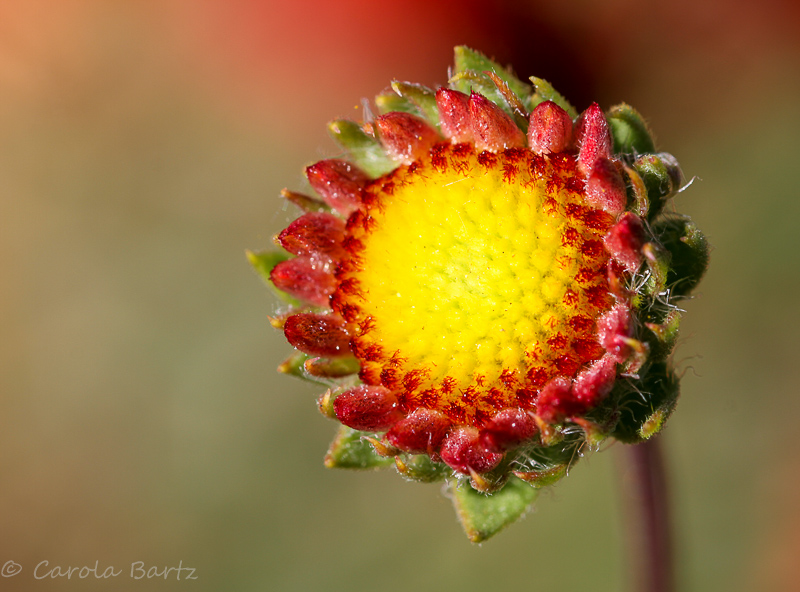
There are not many truly red flowers in my garden apart from the poppies. However, a few years ago I found the red flowering Gaillardia and brought three of them home. This is gaillardia x grandiflora "Burgundy", or more commonly known as Blanket Flower.

There is a good variety of blanket flowers available. I tried a few of them only to find out that they are very short lived - at least in my garden. A yellow variety "Sunrise sunset" has completely disappeared in one location, but does pretty well in another part in my garden. But this red one has been performing really well and is a real stunner. Last year I bought two more which to my surprise produced longer stalks which is simply lovely.

Bees love them.


They do well both in humid and dry conditions, but generally do not need much water once established. It seems to be the perfect choice for my low water garden.

They start as small flowers with tiny petals that eventually open to the stunning flower you see in the top picture.


They keep for quite a while, feeding bees and other nectar loving insects. But their beauty is not over when eventually the flowers fade and the petals fall. On the contrary. They develop a big round seed head that is quite spectacular on its own.


I am planning to plant some more of these gaillardias in a different part of the garden and see how they do there. Gardening involves so much trial and error, but it's always exciting.