Showing posts with label ebooks. Show all posts

Monday, January 16, 2023

T is for Through the Year with Books


Do you keep track which books you read or listen to throughout a year? I started doing that 15 years ago and sometimes I look back what books I read and which "ranking" I gave. My ranking changed over the years - in the first years I gave one star for books I really liked. Eventually I introduced two stars for books that spoke even more to me. And in 2021 I added a third star for exceptional - it went to Nora Krug's "Belonging". No other book since then earned a three star rating.

When I look over my notes of last year I realize that I was very hesitant in giving any stars at all and only four books earned a two star rating - "The Midwife of Hope River" by Patricia Harman which was very atmospheric and brought the Depression era in Appalachia to life; "When the Moon is Low" by Nadia Hashimi who is a favorite author because of her description of the life of Afghan women; "The Storyteller of Casablanca" by Fiona Valpy which describes the life of Jewish refugees in Casablanca during World War II and is interwoven with the life of a woman in contemporary times. Having parallel stories in the past and the present seems to be a very popular way of novels these days and I don't always enjoy it, but in this novel it was well done. This book I actually listened to and enjoyed the narrator, Elizabeth Knowelden, very much.

The fourth two-star book is "Leave only Footprints" by Conor Knighton. Starting with a sunrise on Cadillac Mountain in Acadia National Park on January 1, he travels to every US national park within a year, ending with a sunset at Point Reyes on December 31. While he is not describing every national park, he highlights less visited places (without forgetting popular destinations like Yellowstone etc) and tells interesting tidbits. He writes about the recovery program of the Channel Island fox that was connected to the disappearance and eventual re-introducing of Bald Eagles - fascinating. He describes the problems of Big Bend right on the border to Mexico. He went to American Samoa and what he writes about this national park - the least visited because of its location - made me want to go there one day. As someone who has visited many of the American national parks I recognized much of what Knighton wrote, I learned a lot and most of all I was fascinated by his description about the people and nature.

He also writes about star gazing in Nevada's Great Basin National Park which is an International Dark Sky place (remember when Erika wrote about it?). That leads me to another interesting book I read last year - "Under the Stars" by Matt Gaw.

Even though it says "A Journey into Light" on the book cover, it is a journey into night - with all its natural light sources of moon and stars. He talks about light pollution and its consequences and then visits several designated dark sky places in Britain. He describes his walks in darkness and his fears at the beginning of such an outing, only to become familiar with the darkness and embracing it. It made me curious about these designated dark sky places and I found out that right here in my area there is a place that is on its way to becoming a dark sky place - Point Reyes National Seashore.

I love to read mystery novels. Of course there are the popular ones that everyone seems to read like Elly Griffith's Ruth Galloway series which I enjoy a lot. But I found a few Northern European authors whose kind of dark crime novel speaks to me - Viveca Sten wrote an entire series that takes place on Sandhamn outside Stockholm, but her "Hidden in Snow" is not part of this series. Its setting is further up north in the mountains of Sweden close to the Norwegian border. This book is much more atmospheric than the Sanhamn murders (which I think have been made into a TV series). The other authors are Icelandic Yrsa Sigurdarddóttir's "The Silence of the Sea" (very dark) and Eva Björg Ægisdóttir's "The Creak on the Stairs" which is the first book in the Forbidden Iceland series. Before this book I wasn't familiar with the term Nordic Noir, but now I am. Dark and chilling. At the end of the year, I read on Elle's blog about the DCI Harry Grimm series by David J. Gatward and read the first book in the series. It's not your typical detective novel but rather unconventional written with a lot of humor - and boy, they do eat and drink a lot there!

Of course I also read German books - thankfully every year we have a book sale at the German School where I teach, and this year I found quite a good selection of interesting books.

crim

One genre that seems to be very popular in Germany is crime novels that are located in the North of Germany, mainly Ostfriesland (Northwestern Lower Saxony) and Schleswig-Holstein, the Northern most state in Germany. Of these books I especially like the novels by Anette Hinrichs. Her main characters are two detectives, a female from Flensburg, Germany, and a male from Padborg, Denmark. Since their regions are so close to each other, they often work together on cases that involve both Germany and Denmark. What I like about these books is all the background information about this particular region that has a Danish minority population that brings its own difficulties. One of Hinrichs's books deals with the refugee camps in Denmark at the end of World War II where thousands of Germans (including my paternal grandparents and aunt) landed after fleeing East and West Prussia by ship. It was a highly interesting read.

Of course there are a lot of gardening books that I read in 2022 - I never get tired of these. One of the most interesting and eye-opening books was Douglas Tallamy's "Bringing Natur Home". This year I want to read his "Nature's Best Hope" and learn more about his "Homegrown National Park" movement.


While reading, I often enjoy a glass of wine, plain water - or a nice hot chocolate; whipped cream on top doesn't hurt. This is for Bleubeard and Elizabeth's T Tuesday - I'm so glad that Elizabeth is hosting this year - the 10th! - again.


Monday, February 21, 2022

Books


Again, I am late writing about the books I read (or listened to) last year - but better late than never.

In 2021 I read 64 books, seven of them were audiobooks (so "read" is probably not the right term). As I do every year, I wrote all of the titles and authors down and used my very own star system for books I enjoyed more than others. Usually I give one star for a good read and two stars for a very good read, but last year for the very first time I had to introduce three stars - just once. Everything else without a star is an average read. I still need to figure out how to "star" exceptionally bad reads. Usually I don't finish those and note that in my list, but in 2021 I finished all the books. 

Most of the books I read on my Kindle Paperwhite. It's so easy to take it anywhere and wherever I am I have an entire library with me. I don't like to schlepp any books with me anymore like I used to do for most of my life.

But of course there are still "real" books I'm reading like "The Four Agreements" that I took home from work. That was at the beginning of the year, I had just processed all of the copies and was quite curious about this book. It ended up in the one-star category.


"A Stone in my Hand" was another book from the high school library that I enjoyed. It's written from the perspective of a pre-teen Palestinian girl who lives in Gaza. It was highly educational.

More one-star reads were "The Story of Arthur Truluv" by Elizabeth Berg (I have yet to read a book by her that I don't like), "The Moonlight Child" by Karen McQuestion, "The Light Through the Leaves" by Glendy Vanderah, "The Key" by Kathryn Hughes and "The Keeper of Lost Things" by Ruth Hogan that I listened to. "Nomadland" by Jessica Butler, "Freckled" by TW Neal (she usually writes mysteries as Toby Neal, but this one is about her childhood in Hawai'i), "Where the Forest Meets the Stars" by Glendy Vanderah, "Dovetail" by Karen McQuestion (audiobook), "The Paper Bracelet" by Rachael English (another eye-opener about a home for unwed mothers in the 1970s in the West of Ireland) and "The Midnight Library" by Matt Haig (audiobook, narrated by the wonderful Carey Mulligan) all received two stars,

One Saturday our German School had a book sale in the parking lot of our campus. I got a few German books that interest me - "Nordlicht" is another mystery that is set in the North of Germany. These kind of 'local' mysteries are quite popular (I read quite a bit of those on my Kindle). This was quite interesting since it was set in a small town on the German-Danish border and I learned quite a bit about this special area that I wasn't aware of before.


The book at the bottom is of special interest for me. It's about displaced Germans after WWII, mainly those who had to flee from the approaching Soviet Army in the Eastern regions of the country. This is what happened to both my parents and their families.

Two of my German students gave me books as well - one because I love to read mysteries, and one because he wanted to know my opinion about it.


"Northern Spy" is more than just a mystery, it's about how the IRA still operates 20 years after the Good Friday Agreement. I had no idea and this book was a hard-to-swallow lesson. "On Being German" with the subtitle "A Personal Journey Into the German Experience" mainly angered me. The only interesting part was the diary of the author's mother about the time when they had to flee from their home in East Prussia. But the rest was hair-raising and appaling. 

If someone is indeed interested in a "personal journey into the German experience" I recommend this book:


I have this book in both German and English (Nora Krug wrote both of them herself, no translator) and this is my three-star read. Nora Krug is 17 years younger than I am, but her experience, her way of coming to terms with German history, the guilt and how to define "Heimat" (home or homeland - there really is no equivalent English word for it) is very similar to my own experience, even though I grew up in a refugee family while her family came from and had lived in the Southwest of Germany (these are two very different conditions that you are mainly aware of when you belong to the refugee side). So much sounded familiar. This is not a "regular" book - all is "hand printed" with the author's own illustrations, historic photographs and documents. Here's an example:


I owe it to my German friend B. who told me about this book.

You do know that reading makes thirsty, right? And since this is a T Tuesday post I'm showing a drink at my favorite place to read - in the garden with a glass of rosé. Life can be good.


Monday, February 15, 2021

Books and Beyond


Although the pandemic created much more work for me than in the years before, it also provided me with many enjoyable hours of reading. I read 55 books in 2020 (both as ebooks and "real" ones), 5 less than in 2019, but I'm not reading for the numbers anyway. However, I do find it interesting to see by the end of the year how much I have read over the past 12 months.

As usual I made a list of all the books I read including my rating system of zero, one or two asteriks. No asterik is for "okay", one is for "really enjoyed it" and two is for "outstanding". If a book is plain horrible or I didn't finish it I make a note about that as well.


 There are a few I want to mention here.

Four books got two stars - "This Tender Land" by William Kent Krueger, "One for the Blackbird, one for the Crow" by Olivia Hawker, "The Splendid and the Vile" by Erik Larson and "Memories of the Drift" by Melissa Payne. The last one was, if I remember correctly, an 'Amazon First Read', therefore I didn't have high expectations. Usually I find the 'First Reads' rather disappointing with a few exceptions - the best 'First Read' I ever read was "The Odds of Loving Grover Cleveland" by Rebekah Crane - and I was plesantly surprised about "Memories of the Drift". I started rooting for the main character and loved all the other characters in the novel as well. There wasn't a single bad character and everybody was there to help the "heroine". I can't tell you more because it would mean to unveil too much, you have to find out yourself.

"The Splendid and the Vile" drew my interest when one of my students talked about it in one of my German conversation classes I offered over the summer. It describes Churchill's first year in office as prime minister 1940/1941 - I learned so much about him - he really was quite a character -, but also about his family and his cabinet. A great read that I recommend to anybody who is interested in British history.


Since the hand knitted items in my shop became in higher demand I had to sit and knit quite a lot, but I finally discovered audiobooks! I tried audiobooks when Amazon offered me a free audiobook for rent - it was "Everything my Mother Taught Me" by Alice Hoffman and I loved it. Then I listened into "One for the Blackbird, One for the Crow" which was on my wishlist anyway. I loved the narration by Jackie Zebrowski and decided to try Audible for free for a couple months. I enjoyed this book so very much. The often rough voice fitted the harsh setting of the novel, but Zebrowski changed her voice for each character - from hard to very soft. It is excellent.

Another audiobook I enjoyed was "The Dutch House" by Ann Patchett, read by Tom Hanks. He narrates very "Tom Hanks like", but I enjoyed that very much as well. Many socks got knit while I was listening to great (and less great) novels. In the end, however, I decided not to subscribe to Audible since I just didn't want to spend the money on it - and I had also started listening to podcasts.


I quickly found the excellent podcasts by the BBC World Service - my favorites were "13 Minutes to the Moon" about Apollo 11 and Apollo 13, and "Fall of the Shah". I also listen regularly to "The Daily", a podcast by the New York Times.

Since I taught a new class at the German School I also had to read for work - in this case "Writing Down the Bone" by Natalie Goldberg. This book gave me good basic ideas how to structure my creative writing class and also for my own growth as someone who loves to write.


I shall not forget the books that took up a lot of my time - books I enjoy over and over again. Every year I buy new ones and go back to the old ones. Of course I'm talking about gardening books.


One of the most interesting ones was "Gaia's Garden" by Toby Hemenway, recommended to me by an online friend in Australia whose gardening climate is similar to ours. This book was quite an eye-opener and I spent considerable time in my garden to implement some of the ideas. Not all of them work, but those that I chose to try out have worked out beautifully.


And in November, I bought this book (on the day it came out, actually), I am still reading and truly enjoying it.


What did you read during the pandemic?

Sunday, January 12, 2020

Books and a Movie


As I have done over the past couple years I take a look back at the books I read in 2019. Most of the books I read on my Kindle, but every now and then I sit down with a "real" book. Some books are very impractical for the Kindle, like art and photography books, cookbooks etc.


In 2019 I read 60 books including two audiobooks that we listened to while traveling to Arizona. I always write the titles down in a big notebook, noting the author and when I have finished it. I also scribble a little star next to the title if I really liked the book. When I look at that list now I see that I was far less generous with those stars in 2019, but I also introduced the two-stars for excellent reads. And I'm happy to see that there are three of them.


These three novels are "The Summer Guest" by Justin Cronin - a story about a family and their summer guest set in a remote area in Maine that pulls you in right from the beginning with well developed characters and written in a beautiful language -, "When we Believed in Mermaids" by Barbara O'Neal - the story of two sisters who had lived apart for many years, believing that one of them was dead; set in Santa Cruz and New Zealand I was drawn in by the unusual story line and the many questions that came up about my own life while reading this novel - and "The Storied Life of A.J. Fikry" by Gabrielle Zevin - a very slow, beautiful story about a book seller whose life gets shaken up and takes an interesting and wonderful turn when he finds a mysterious package at his store. Other books I liked are "Eleanor Oliphant is Completely Fine" by Gail Honeyman, "Where the Crawdads Sing" by Delia Owens, "To See and See Again" by Tara Bahrampour and "The Trouble with Goats and Sheep" by Joanna Cannon. There were also books I truly disliked, eventually only scanned or didn't finish at all, like "The Handmaid's Tale" by Margaret Atwood. I also read Margaret Craven's "I Heard the Owl Call my Name" again, my all-time favorite.

Over the summer break I took home a few books from the high school library because I thought it's a good idea if I knew what the students are reading in English class, and there were quite some books I hadn't read before.


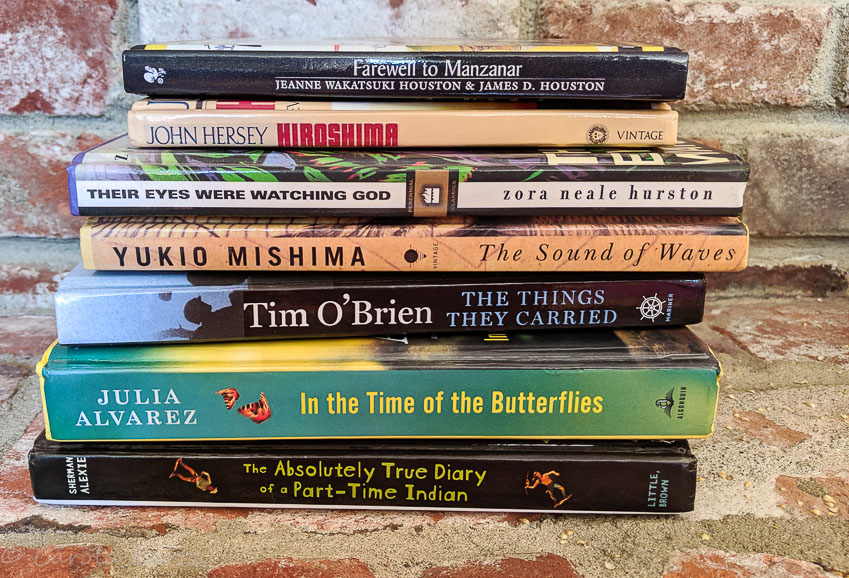
My favorite among these books is "The Absolutely True Diary of a Part-Time Indian" by Sherman Alexie which is hilariously funny and sad at the same time. Great read for high school students!

But there were also other books in 2019 - like this wonderful cookbook. I had read about it in our local paper's "Home" section and was intrigued. It's full of recipes of immigrant women, who were trying to bring some of their home countries to their new home by cooking the familiar food. But it's not only recipes you can find in this gem of a cookbook. It's the stories of the immigrant women that makes this book so precious to me since I am an immigrant myself. I still have to try any of the recipes, but I'm determined that 2020 is the year for that.


Of course there were books about photography, some of them I pull out again and again.


David DuChemin is one of my favorite photographers, but as a humanitarian he is also a tremendously inspiring personality. I love to listen to his podcasts, he has a very open mind and what I love about him so much is that he has a lot of advice and inspiring ideas, but he never uses the words "you should". In contrast to that, "Shooting with Soul" was a bit disappointing - some nice ideas, but it certainly didn't inspire me in the way "The Soul of the Camera" did. I'm working my way through "Zen Camera" bit by bit and can't say very much about it at this time.

Just like last year I couldn't resist some "drool" books. "Chasing Light" had been on my mind for quite some time. I had first seen it in one of the visitor centers in Yellowstone National Park in 2017, but had opted for a different book back then. When I saw it again in the visitor center of Saguaro National Park last spring I saw that as a "sign" and bought it. I did not regret it.


There are two more "difficult" books I want to talk about here, books about local matters. About the October 2017 firestorm, to be precise, the one that wiped out several neighborhoods in my town. "Pointe Patrol" is the very personal story of one home owner who along with some neighbors and his dog patrolled their neighborhood after that fateful night on the one hand to prevent further fires since there were still some smoldering and on the other hand to deter people from looting. I was only able to read it in bits and pieces since it brings back so many painful memories. Brian Fies' "A Fire Story" is a graphic novel that he started right after the first night when he had lost his home and tells his own personal story. The first "chapters" of his book appeared within the first week of the fire if I recall correctly. It is raw and very emotional.


Before I leave I want to mention a very special movie I watched (again) this year. I had shown it to my German students at the 30th anniversary of the fall of the Berlin Wall. It describes the events before November 9th, 1989, particularly what happened in the West German embassy in Prague. "Zug in die Freiheit" (Train to Freedom) is a documentary with time witnesses, original footage and played scenes. I have seen it several times, but every time I feel the same emotions, the tight knot in my stomach, the utter relief at the end. Even though I know how these events ended, it keeps the moment of that autumn 30 years ago very real and alive for me. You can find a preview of the movie here: https://vimeo.com/107603939 and it is possible to rent it on Vimeo. Luckily the violent scenes you see in the preview are only rare ones in the movie, but they are heartbreaking nevertheless.


What were you reading in 2019? Tell me in the comments.


Tuesday, January 29, 2019

What I read in 2018


Before the first month of 2019 is over I thought I want to write at least one post for my blog. I can't believe that I haven't written anything since we said goodbye to 2018 - this month just flew by in all its busy-ness. But finally I'm here, and what better topic to write about than books?


My book shelves are still in a state of complete disorganization, but thanks to my Kindle Paperwhite I didn't add many new books to the chaos. I did, however, add a lot to the Kindle.

I read 61 books in 2018 and put them all in my "read" folder - I like this way of organizing books.


I also list them chronologically in a big notebook - title, author and when I finished it. If I particularly enjoyed a book it gets a little star at the title - when I look back at the list I realize that I enjoyed quite a good amount of books last year. This is the way it should be, right?


Some of the novels that I loved are "War Brides" by Helen Bryan, "Cara's House" by Annie Katz, "The House between Tides" by Sarah Maine, "The Forgotten Girl" by Kerry Barrett (wow, what a story!), "Whisper Me This" by Kerry Anne King, "Beneath a Scarlet Sky" by Mark Sullivan and "The Secret" by Kathryn Hughes. For some reason I fell in love with "Red Mountain" by Boo Walker which is not even an outstanding book, but it's a sweet story and I like almost all of the characters. That doesn't happen very often.

My favorite book, however, was "The Keeper of Secrets" by Julie Thomas. The title suggests chick lit, but it's anything but. It's the story of a special Guarnieri violin from the 1930's in Nazi Germany through the time of the Soviet Union to present day America. It's gripping, often sad, and beautiful. I learned a lot about violins and music in general. When I was done I had to listen to Bach's violin concerto that is mentioned in the book and re-discovered my love for classical music.


As some of you know I also enjoy reading mysteries. I hard started the "Huntress" series by Alexandra Sokoloff in 2017 and read the remaining four "moons" in 2018 ("Blood Moon", "Cold Moon", "Bitter Moon" and "Hunger Moon") and think there are more "moons" to come. It's actually not a mystery but downright thrillers. The interesting thing is that the reader roots both for the detective and the murderess (who also develop some feelings for each other). It's not so much a "who done it" but "why" and the entire background story. I was going through a whole range of feelings while reading these books and they have never quite left me. Another author of mysteries is Viveca Sten, a Swedish writer whose books I discovered this year. The Sandhamn Murders series takes place on a small island (Sandhamn) near Stockholm and not only deal with the crimes but with the daily life and its challenges of the main characters. The first in the series is "Still Waters" and I would start out with that (the Sandhamn Murders as well as The Huntress series should be read in the right order to fully understand what's going on).

Of course I also read German literature. I re-visited one of my favorite writers of short stories, Wolfgang Borchert, who died in 1947 at the age of only 26. One of his most endearing stories is "Nachts schlafen die Ratten doch" (The rats do sleep at night), that in all its sadness and desperation is uplifting in the end. I have decided to use my German language students as guinea pigs and read this story in class.


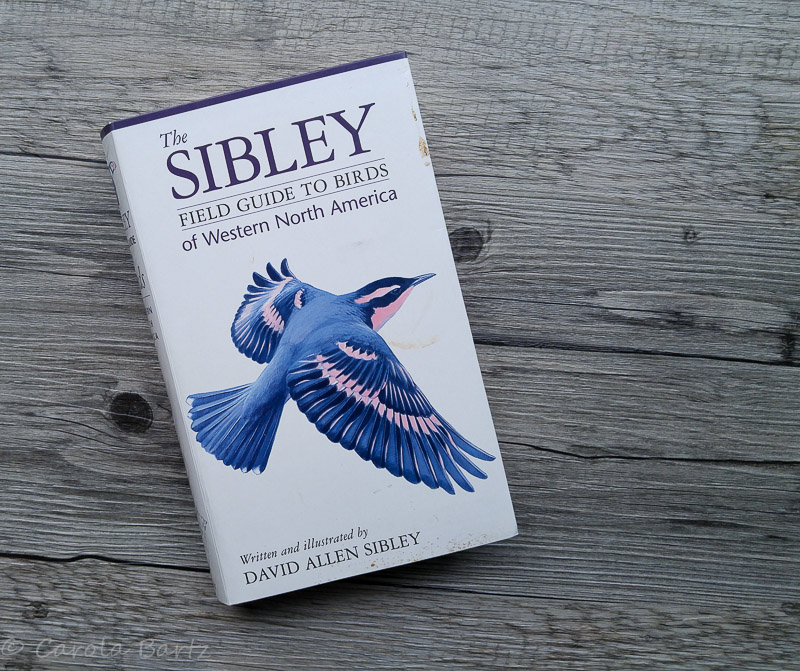
One of the books I used the most is this one - my trusted Sibley.


In my opinion it is one of the best guides to birds, and so far I have found in here every unknown bird to me I ever saw. I only wish it came with a disk or a link to the sounds of the birds as well.

Other books I consulted over the year or looked into over and over again are these ones:


Shortly before Christmas my private student gifted me a beautiful book in a sturdy box and with a giclée print of one of the paintings of the artist. It is about the art of painter and naturalist Thomas Quinn who grew up and lived in Marin County (the county between here and San Francisco). It shows many if not most of his watercolors as well as quotes and poems, some written by Quinn himself. The book is exquisitely done (my student was the printer of that book) and a true treasure.


Now let's go back to reading, shall we?