Monday, May 8, 2023

Into the Redwoods


California's Coast redwoods, Sequoia sempevirens, are among the largest and oldest living organisms on earth. Fossil records show that redwoods grew during the Jurassic period, at least 200 million years ago. They are exceptionally long lived. The oldest known coast redwood dates to 480 BCE.

Up North in Eureka in Humboldt County on the coast is Sequoia Park, a grove of redwoods with a Sky Walk. This Sky Walk is 100 feet above the ground and offers a different view up into the canopy of these majestic giants. I had long wanted to go up there - it's an four hours drive to Eureka - and when Kaefer was here in February we finally made the trip up there.

But first - breakfast. We started very early in the day and arrived in Ukiah just in time for a breakfast treat and some really good coffee at Black Oak Coffee Roasters. This beautiful cup of delicious coffee hopefully qualifies as a drink for Bleubeard and Elizabeth's T Tuesday.

Very soon we were back on the highway, winding our way up into the mountains. The heavy marine layer got lighter and finally broke off completely. A beautiful sight!

This is an area deep in the forested mountaineous area with absolutely no reception - here, you can still find these things in the reast areas on the side of the highway. Remember those?

It was late morning that we arrived at Sequoia Park. We got our tickets and walked over to the Sky Walk. Oh, what a sight!


Redwoods can reach an age as much as 2,500 years. The trunk diameter is as wide as 29 feet (8.8 m) and its height as high as 380 feet (115.8 m). For such tall trees, redwoods have surprisingly shallow roots, seldom more than six feet (1.8 m) deep. But what they lack in depth, they make up for in width. The root system of a mature old growth redwood can be more than 300 feet (91 m) in diameter. This root system and its shallowness can be a real challenge in an urban setting, where people unfortunately have planted these trees without taking its height and root system into consideration. Eventually, they will buckle up sidewalks and streets and can even damage the foundation of buildings. Simply taking out a redwood is not that easy - they are protected and require a special permit for removal which is quite expensive. Best solution: don't plant one in your backyard or in front of your home - it doesn't belong there in the first place. (When we were looking for a home to buy, a redwood in the garden or next to the house was a no-no for us; now, we have a small redwood grove across the street.)

This was the comfortable, sturdy part that is also wheelchair accessible. It slowly makes its way up into the trees.


Then there were the not so sturdy parts - the real fun part, high up among the trees.


We were able to get a close look at the bark of the trees. There were signs requesting not to touch the trees, just use our eyes. I just hope everybody respects that.


Before logging began, these massive and majestic trees covered more than 1,500,000 acres from Big Sur to just past the Oregon border along a coastal corridor less than 40 miles wide. Today only a tiny fraction of that ancient forest remains, much of it in Humboldt County. 

Redwood has been woven into the fabric of life on the North Coast for hundreds of years. First Nations peoples revere the trees and traditionally relied on them for shelter and canoes. Euro-Americans harvested redwoods in almost unimaginable quantities to build towns and cities across the West (our home is built of redwood), all but eliminating original old growth forests.

Looking down and looking up...


Redwoods are fire resilient. Large trees are able to survive moderate intensity fires, but if their crowns are scorched, leaves can be damaged or killed. Fire damaged redwoods have the astonishing ability to regrow their crowns and sprout new trunks from their base. You can imagine how important this is in our landscape that experiences wildfires every year.


Even though it was a sunny and moderately warm day (after all this was in February), it was quite chilly in the redwood grove. We felt the dampness hanging around and lowering the temperature quite a bit. However, the redwood canopy teems with life. Plant species normally found on the ground take root in soil formed from decomposed redwood needles, twigs and bark flakes. Lichen and mosses grow on the thick bark. Insects and birds flit among the branches and animals scurry about, some communting to the forest floor, others permanent residents.

Simply put, it is fascinating.


Wednesday, May 3, 2023

Cloudy Morning Walk


This morning I went to the farmers market and on my way back home I spontaneously decided to stop by the lake. It had rained the day and night before, so everything smelled so fresh. Some of the trails were a bit muddy but not too bad. Since I hadn't planned on this, I didn't have my camera with me. All of these photos were taken with my cellphone.

This little guy was my "greeter" when I left the parking lot - and he wasn't the only one. I hadn't seen that many Acorn Woodpeckers in this place before! 

It was a cloudy morning with still some rain dropping every now and then. The reflections were lovely. The lake seemed so calm.


There were wildflowers on the side of the path and up the slopes. Some of them I had seen in the other parks, some not.

California Buttercup (Ranunculus californicus), a native...


... Forktoothed Ookow (Dichelostemma congestum), another California native...


... and of course our state flower, the California Poppy (Eschscholzia californica).


More views of the lake:


This little family kept a safe distance from the shore.


There were several thistles, but I have a hard time identifying them exactly - there are so many different kinds that all look so similar.


Hairy Vetch (Vicia villosa) is found throughout much of North America where it is naturalized (it originated in Europe and Asia).  It's a very sweet flower that can cover large areas.


Rattlesnake Grass (Briza maxima) is not native, but located throughout the coastal ranges of California, and has spread into many grassland regions. It is quite invasive, but its ecological impact is minor. It's one of my favorite grasses and makes a great companion for the Hairy Vetch.


This, however, I wasn't happy to see - French Broom (Genista monspessulana), an aggressive invader that forms dense stands that exclude native plants and wildlife. It's increasing fire hazards. It looks beautiful, but appearances are deceptive. I hope that the goats will eat it to the ground (before it sets seed) when they will be brought in a bit later in the year (one of the Regional Parks' way to keep fuel for a wildfire to a minimum).


The Miniature Lupines (Lupinus bicolor), however, were a very welcome sight.


The lake area is not short of crooked and dead trees. The second one is my personal favorite.


It was a lovely walk.


Getting out and about makes hungry eventually. What about some cheesy and spicy black bean bake? It was quite filling! This is for Rain's Thursday Art and Dinner Date.


Monday, May 1, 2023

Morning Hike in the Laguna


After I had been to Crane Creek on Wednesday, I decided to hike in the Laguna Wetlands Preserve on Friday morning. Thursday had been a hot day with temperatures in the lower 90s, but Friday was a bit cooler. I decided to go early since the Laguna has a lot of open spaces without much shade and it tends to get quite hot.

This is a premier bird watching area and when I was getting out of my car, I was greeted by a Brewer's Blackbird who loudly announced my arrival.

Only a few minutes later a Red-winged Blackbird landed on another "Boundary Trail" post and I saw a  Song Sparrow on a fence post (I think; I have a hard time identifying sparrows). I heard Red-shouldered Hawks but wasn't able to take a picture, instead I captured this majestic Turkey Vulture.


I started my walk looking for wildflowers, but in contrast to Crane Creek two days before, I didn't see any native wildflowers. This is a completely different terrain, very wet in the winter and extremely dry in the summer. 

Ribwort Plantain (Plantago lanceolata), a non-native noxious weed, but so far not on the invasive plants list - yet. It's beautiful.


Common Salsify (Tragopogon porrifolius), an edible root plant. I have many of them in my garden. 


Wild Radish (Raphanus sativus), non-native as well, that forms pretty clumps in the meadow.


Meadow Foxtail (Alopecurus pratensis) on the left, which is potentially invasive and, of course, non-native. On the right is Wall or Foxtail Barley (Hordeum murinum), non-native as well, and I have seen it in some places really taking over the space. Fortunately so far it behaves here.


My favorites are the remains of Queen Anne's Lace (Daucus carota), they are so fragile and beautiful. Very soon the new ones will come up - it's a great pollinator plant.


The oak gall (on the left) is an abnormal plant growth found on foliage and twigs of many species of oak trees. They are produced by small oak gall wasps. Adults lay eggs in expanding tree buds and leaves in the spring, the larvae then feed, pupate and emerge from the gall as adult wasps. These galls do not cause significant damage to trees. The plant on the right is a different story. This is non-native Curly Dock (Rumex crispus), an edible weed that is found in many open areas of the Laguna. It matures to a rusty red in late summer and fall - maybe that color gave it its botanical name, it does look rather "crisp" in the fall.


Very soon I turned to the left, one of my favorite trails in the Preserve.


It didn't take long until I reached one of the creeks. Signs of the wet winter were everywhere, but the water of the usually flooded area in winter has already receded a lot.


This female Mallard enjoyed hanging out on this tree stump, her companion not far away.


I always love the Laguna de Santa Rosa with its many trees that are reflected in the water. The seasonal bridge wasn't in place yet. In winter many many Black-crowned Night Herons, Green Herons and Cattle Egrets roost here, but this time I only saw one Green Heron taking off.


This is where I usually cross over to the meadow. Good thing I was wearing my hiking boots!


So close to the meadow there are many birdhouses put up in this area. 


The meadow is called Meadowlark Field, but so far I have only heard the Western Meadowlark here, but have never seen it. Apart from the beautiful trail I showed you above, this is my favorite part of the Preserve. There are some beautiful oaks standing here, but most of the trail through the meadow is in full sun.


I often stop at the tree above and sit at the picnic table, writing in my journal or just day dreaming. There are not that many people who walk this part of the trail.

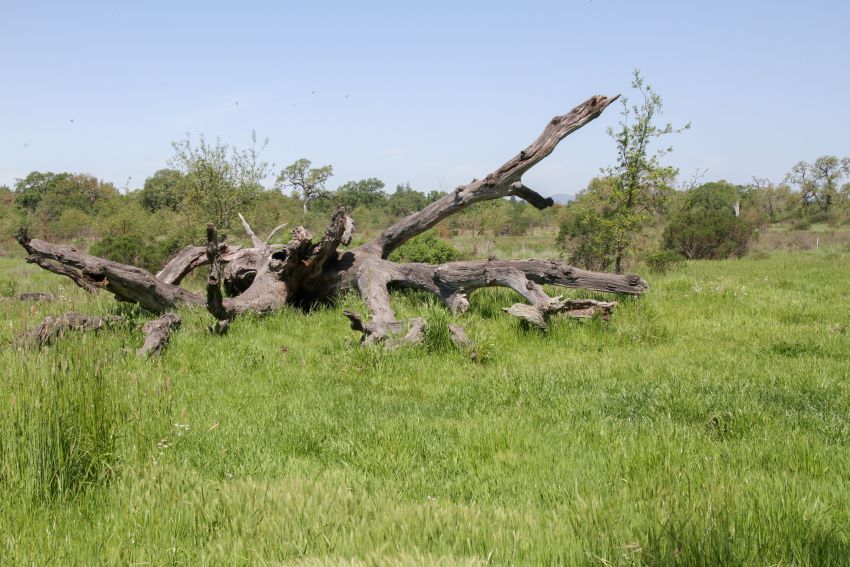
Of course, the Laguna is not short on crooked and dead trees.


Look who was hanging out on this dead trunk in the photo above!


And there's another one!


On my way back to the parking lot I saw some California Poppies - finally some native wildflowers! They do pop with their happy, feel-good color.


Since this is for T Tuesday over at Bleubeard and Elizabeth I need to provide a drink. We already saw some birds in this post and I will finish it with one - one of my bird mugs that is my morning coffee mug. I love my coffee with lots of milk - my black coffee-days are long over. The roses are from my garden, "Sheila's Delight". And if you're wondering about the vase - it's a wine bottle that my wine maker friend cut down to serve as a vase. Recycling at its best.