Showing posts with label redwoods. Show all posts

Thursday, September 12, 2024

A Cabin in the Redwoods


When we spent the long Labor Day weekend in Gualala, we stayed in a lovely little cabin in the Redwoods along beautiful Highway 1, right across from the Pacific Ocean.

But before we got there, we met with our very good friends B and P at the Navarro Winery in Anderson Valley for our annual winetasting picnic. We started doing this last year and decided then to let it become a new tradition. B and P - a German-American couple - are very close friends of ours whom we met through our German Stammtisch group (curious what a Stammtisch is? Find out here). We spent four wonderful hours together in the beautiful vineyards of this winery off the beaten path that makes fantastic wine at an affordable price.

This one is for Nicole's Friday Face Off

After that the Geek and I were on our way to Gualala and our little cabin. It is a basic cabin, nothing fancy, and it's right at the Redwoods.


It has a decent sized room with a bathroom and a beautiful deck at the back. The skylight is right above the bed and I enjoyed looking up into the canopy of the trees. 


The room has a cozy little sitting nook where we had our breakfast and enjoyed a glass of wine in the evening while chatting, reading and knitting. The heater was very helpful in the chilly mornings and evenings.


The homemade breakfast was brought to our door every morning. It was delicious.


The Naked Ladies (Amaryllis belladonna, native to South Africa) were in full bloom and the deer weren't shy at all and seemed to hang out on the premises a lot. 


And finally, the view of the ocean. 


On the first morning we went to Gualala Point Regional Park. While Gualala is in Mendocino County, the regional park is still in Sonoma County and we could use our Regional Parks Pass here. The border between the two counties is in the middle of Gualala River which flows into the ocean at Gualala Point.

The first view of the ocean is from near the visitors center.


We decided to first go to the beach. Instead of walking down the paved path, we took the dirt trail through the "tunnels".


I was delighted about the Naked Ladies in the meadow, but not so much about the Pampas Grass (Cortaderia selloana). As the name says, Pampas Grass is native to southern South America and a highly invasive species at our coast. It looks beautiful, but it does a lot of harm to our native plants.


Someone had planted Nasturtium (Tropaeolum) on top of the cliffs and it was hanging down the cliff wall. Nasturtium is native to South and Central America, but as far as I know it is not invasive. It sure looked stunning in this location.


The beach is long and slightly curved with lots of driftwood and, of course, an abundance of gulls.


All this walking, taking photos and beachcombing (I took home some beautiful small driftwood for future art projects) makes hungry, so we decided to eat at our favorite seafood shack in town. Rockfish and chips on one day, a spicy tuna melt on the other. The three hispanic girls who work in this shack (and who might be the owners) are always very nice and pleasant, and their food is excellent. I'm really glad they made it through the pandemic. Other than many shacks I have seen in the States, they try to keep their single-use things at a minimum - the only plastic is the little container for the sauce and they use food grade paper to line the baskets. We have been going here for years and we have never been disappointed. Afterwards it was time for coffee at Trinks on the cliffs with a view of the ocean - Aztec Mocha for the Geek, a regular Mocha for me. Yummy.


My favorite part of Gualala Point, however, is not the beach, but the Bluff Trail. It offers endless views of the ocean along a narrow trail. We had expected foggy and cool days in Gualala as the weather so often is like that at our coast, but we had sunny weather throughout with temperatures in the 60s (a lovely relief to our much warmer inland temperatures). This made walking along the Bluff Trail even more enjoyable.


Of course I was delighted by all the plants we saw along the way as well as the often very gnarled trees. There are "tunnels" here as well - I actually call this trail the Hobbit Trail as I can picture it in Middle Earth.


Beautiful views everywhere...


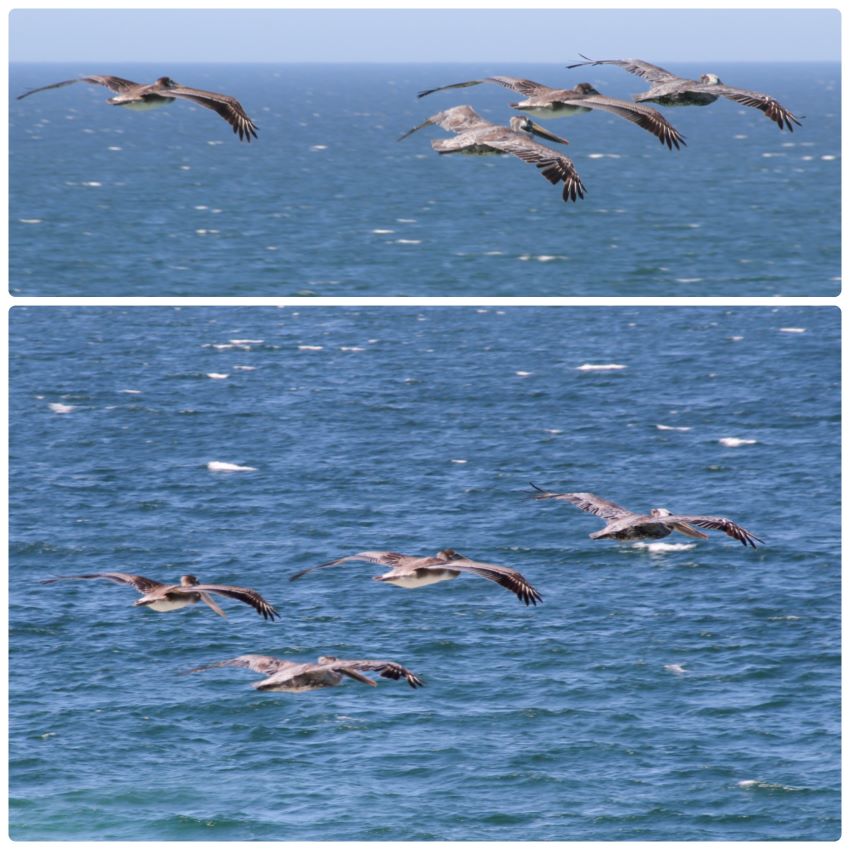
And to my biggest delight we saw so many Brown Pelicans (Pelecanus occidentalis)!

A little fun sidenote: A writing, office and art equipment company in Germany is called Pelikan. It was founded in Hannover in 1838. My first fountain pen I got (in first or second grade) was a Pelikan one and I had it for years. Today I'm writing with a Faber Castell fountain pen, but I still use the Pelikan ink cartridges (thanks, Amazon).

And finally a couple pictures at sunset, again at Gualala Point.


Monday, June 24, 2024

Auf der Straße nach Mendocino (On the Road to Mendocino)


 Why a German title?, you might ask. "Mendocino", the German adaptation of the song with the same name by the Sir Douglas Quintet, was a German Schlager (hit song) by Michael Holm back in 1969 and the biggest selling single that year. I was nine years old at that time, right before I started high school (high school in Germany starts with 5th grade). At that time I was still listening dominantly to German pop music, which changed a couple years later when I had learned enough English to at least understand a little bit of all the British pop music that was swapping over to the continent. But in 1969 it was German Schlager for me, and "Mendocino" was a real earworm. Of course I had never heard of a place with that name, had no idea whether a place like that actually existed and had no clue where it would be located.

Fast forward 32 years, when we moved to Santa Rosa in Northern California. On the map I saw that up north along the coast on Highway 1 there was a place called Mendocino. My childhood came back visiting - guess where we took one of our first bigger trips that summer of 2001? 

We fell in love with Mendocino right away when we first saw it sitting on the cliffs. It's a quaint little town, often shrouded in low clouds and coastal fog, with cute little shops - a wonderful independent bookshop, a fantastic optics store where many years ago I bought my binoculars and later our scope, and a delicious chocolate "Haus" among them - and a trail out to the Mendocino Headlands. Mendocino has become our annual Mother's Day trip.

You can drive up Highway 1 to get to Mendocino, but we usually opt to take Highway 128 for the trip to Mendocino (and back along 1), and so we did on this year's Mother's Day as well. After a very good breakfast in Cloverdale, we drove up into the mountains on a very winding road, trundled along the vineyards of Anderson Valley and finally dipped down into the Redwoods.

This is a favorite part of the drive for us. Driving through the forest with those towering trees is truly magnificent. See for yourself:

Of course we stopped several times. It's not just what the forest looks like, but the way it smells. I have always loved the scent of a forest.

It's not only the towering trees that capture my attention, but also what happens beneath them, on the forest floor.


But looking up to the canopy is still my favorite thing to do here.

Shortly after leaving the Redwoods we merged with Highway 1 and drove the last short stretch to Mendocino. The moment we hit the coast we experienced the typical Northern California phenomenon - sunshine everywhere, fog at the coast. In the same old fashion Mendocino appeared overcast and gray. No surprise.

What I like most about this little town beside the wonderful gardens people have here, are the many old towers, most of them watertowers. It's just a couple years ago that Mendocino was in a severe water crisis when much of the drinking water needed had to be trucked in daily. Just imagine that, sitting right next to a huge body of water.

Of course we decided to walk the Point Mendocino Trail out to the headlands. It was windy and chilly, but still we enjoyed it. 


Someone left this bouquet at the bench near the start of the trail. 

When we were in Mendocino last year the Headlands were covered with native lupines, but we were hard pressed to find any this year. Instead, the land was covered with these yellow flowers that I haven't succeeded in identifying.

But we did see some native plants like Checker Bloom (Sidalcea malviflora), Silver Lupine (Lupinus albifrons), Common Yarrow (Achillea millefolium), California Poppy (Eschscholzia californica), Douglas Iris (Iris douglasiana), and California Sea Thrift (Armeria maritima californica).


Of course we also saw gulls, but I'm not even attempting to identify this one since I have a hard time in correct gull identification. I leave that to David who travels with birds.

I was never able to find out the story behind the Mendocino Headlands Totem Pole.

The views from anywhere on the Headlands are stunning and even more so when the sun makes an appearance. We didn't have such luck this time.

Afterwards we got our treats at the Chocolate Haus (so so good) and visited the bookshop where I found Rosanna Xia's book "California Against the Sea - Visions for our Vanishing Coastline". Ever since I had heard her talk in a webinar, I wanted to get my hands on this book. Then we slowly drove back via Highway 1, stopping in Gualala at the Seafood Shack for fish and chips as we always do, and just enjoyed this stunning drive, that always takes my breath away, no matter how often I drive here. The sun finally came out as well and let the ocean sparkle.

Here is a very short snippet of the drive, already closer to home just north of Jenner:


If you are interested to read more about Mendocino, you can find posts and photos (some even with sun!) here, here, and here. 


Monday, May 8, 2023

Into the Redwoods


California's Coast redwoods, Sequoia sempevirens, are among the largest and oldest living organisms on earth. Fossil records show that redwoods grew during the Jurassic period, at least 200 million years ago. They are exceptionally long lived. The oldest known coast redwood dates to 480 BCE.

Up North in Eureka in Humboldt County on the coast is Sequoia Park, a grove of redwoods with a Sky Walk. This Sky Walk is 100 feet above the ground and offers a different view up into the canopy of these majestic giants. I had long wanted to go up there - it's an four hours drive to Eureka - and when Kaefer was here in February we finally made the trip up there.

But first - breakfast. We started very early in the day and arrived in Ukiah just in time for a breakfast treat and some really good coffee at Black Oak Coffee Roasters. This beautiful cup of delicious coffee hopefully qualifies as a drink for Bleubeard and Elizabeth's T Tuesday.

Very soon we were back on the highway, winding our way up into the mountains. The heavy marine layer got lighter and finally broke off completely. A beautiful sight!

This is an area deep in the forested mountaineous area with absolutely no reception - here, you can still find these things in the reast areas on the side of the highway. Remember those?

It was late morning that we arrived at Sequoia Park. We got our tickets and walked over to the Sky Walk. Oh, what a sight!


Redwoods can reach an age as much as 2,500 years. The trunk diameter is as wide as 29 feet (8.8 m) and its height as high as 380 feet (115.8 m). For such tall trees, redwoods have surprisingly shallow roots, seldom more than six feet (1.8 m) deep. But what they lack in depth, they make up for in width. The root system of a mature old growth redwood can be more than 300 feet (91 m) in diameter. This root system and its shallowness can be a real challenge in an urban setting, where people unfortunately have planted these trees without taking its height and root system into consideration. Eventually, they will buckle up sidewalks and streets and can even damage the foundation of buildings. Simply taking out a redwood is not that easy - they are protected and require a special permit for removal which is quite expensive. Best solution: don't plant one in your backyard or in front of your home - it doesn't belong there in the first place. (When we were looking for a home to buy, a redwood in the garden or next to the house was a no-no for us; now, we have a small redwood grove across the street.)

This was the comfortable, sturdy part that is also wheelchair accessible. It slowly makes its way up into the trees.


Then there were the not so sturdy parts - the real fun part, high up among the trees.


We were able to get a close look at the bark of the trees. There were signs requesting not to touch the trees, just use our eyes. I just hope everybody respects that.


Before logging began, these massive and majestic trees covered more than 1,500,000 acres from Big Sur to just past the Oregon border along a coastal corridor less than 40 miles wide. Today only a tiny fraction of that ancient forest remains, much of it in Humboldt County. 

Redwood has been woven into the fabric of life on the North Coast for hundreds of years. First Nations peoples revere the trees and traditionally relied on them for shelter and canoes. Euro-Americans harvested redwoods in almost unimaginable quantities to build towns and cities across the West (our home is built of redwood), all but eliminating original old growth forests.

Looking down and looking up...


Redwoods are fire resilient. Large trees are able to survive moderate intensity fires, but if their crowns are scorched, leaves can be damaged or killed. Fire damaged redwoods have the astonishing ability to regrow their crowns and sprout new trunks from their base. You can imagine how important this is in our landscape that experiences wildfires every year.


Even though it was a sunny and moderately warm day (after all this was in February), it was quite chilly in the redwood grove. We felt the dampness hanging around and lowering the temperature quite a bit. However, the redwood canopy teems with life. Plant species normally found on the ground take root in soil formed from decomposed redwood needles, twigs and bark flakes. Lichen and mosses grow on the thick bark. Insects and birds flit among the branches and animals scurry about, some communting to the forest floor, others permanent residents.

Simply put, it is fascinating.