
Before we go back to Bretagne and (maybe) some prehistoric sites, let me invite you to some of the walks I did in late winter and spring. The first signs of spring are usually visible here in February, but even if they're not, I enjoy being out in nature in every season.
The Lakes, end of February

A fisherman and his dog were looking for a good place to fish. It was the dog who draw me into taking this picture, not the guy...
This Canada Goose (Branta canadensis) seems to have no problem with this acrobatic display while taking a nap. Can you sleep on one leg - without losing your balance?

This was the first time that I saw a Common Merganser (Mergus merganser) - quite pretty, don't you agree?

Golden-crowned Sparrows (Zonotrichia atricapilla - I think) were in the bushes - I usually see them in the colder months. Their song is a bit mournful I think, but I like it and it is very easily recognizable.

A Black Phoebe (Sayornis nigricans - I think) sat in the bushes by the lake. I'm still not very sure in bird identification, especially with these smaller ones.

And of course I'm always drawn to the light. Late winter offers some interesting contrasts.

Crane Creek, March

I came here in the hope of seeing wildflowers, but I was a bit too early. However, the California Buttercups were already in full bloom and painted the landscape with cheerful yellow dots.

A Red-winged Blackbird (Agelaius phoeniceus) seemed to enjoy that as well.

We had a very wet winter and I was glad to still see some water in the creeks that meander through the park.

A Red-tailed Hawk (Buteo jamaicensis - I think) - well, shit happens.

Crane Creek is full of majestic oaks, buckeyes, California bay and lots of dead and/or crooked trees. It's a paradise for Acorn Woodpecker - and for photographers like me.

Sonoma Valley, early April

In a recent post I wrote that Sonoma Valley almost completely burnt during the October fires in 2017. It is amazing to see how nature bounces back from a nature catastrophe like those devastating fires.
A European Starling (Sturnus vulgaris - I think - David, please, correct all my "I think"s) greeted us at the start of the paved trail that meanders through the shady valley.

Everywhere we could see dead trees, either remnants of the fires or just natural death occurrence. They look interesting and were just waiting for me to take a picture.


A Western Fence Lizard (Sceloporus occidentalis) - my new best friend after I had learned about their ability to "de-weaponize" ticks.

This is Purple Sanicle (Sanicula bipinnatifida), another species I hadn't seen before and was glad to find here in the woods.

The shady path through the valley is perfect for walking on hotter days.

Sky Lupine (Lupinus nanus), a native, was found everywhere! They aren't very tall and dot meadows with their bi-colored petals - blue and magenta, how wonderful is that?


Two weeks later when I was at Sonoma Valley again, the Narrowleaf Mule-ears (Wyethia angustifolia) had turned up in many spots. Another native that is found inland in grassland and meadows as well as at the coast.

The Lake again, April
When I walked the less crowded dirt trails a little bit further away from the lake, I finally saw all the wildflowers I was waiting for.
Hairy Vetch (Vicia villosa) and Italian Thistle (Carduus pycnocephalus)

Blue Dicks (Dipterostemon capitatus)

Common Fiddleneck (Amsinckia menziesii)

California Hedge Nettle (Stachys bullata)

This True Cranefly (Tipula luna) was happy to be in the cool shade of the forest.

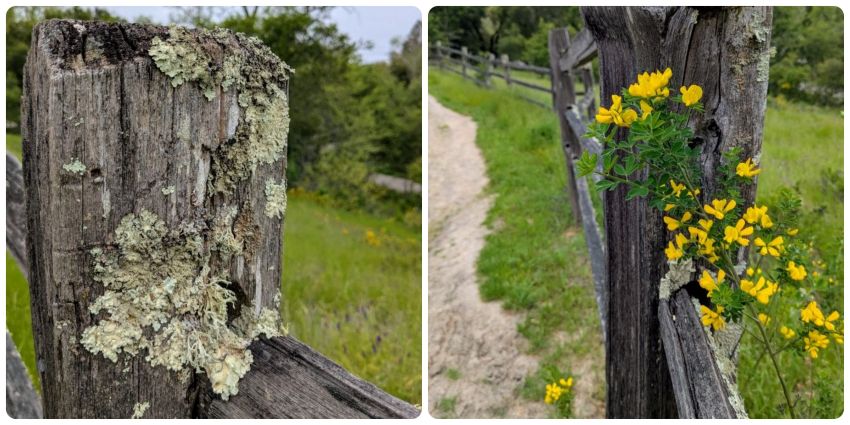
The lichen on the fence was very much to my liking, however, the French Broom (Genista monspessulana) was not. This plant looks gorgeous, but it is an introduced species that is extremely invasive and can take over quickly. What is even worse, it burns easily and can spread fires rapidly.
Do you look more closely at tree bark? I do and find this oak bark very interesting. Nature is full of wonders.

No, I wasn't drunk when I took the following picture - the trees really grow like this along this path. Isn't it a bit magical? I wouldn't be surprised if some elves would suddenly appear among the trees.

I leave you with a shot of two Turkey Vultures (Cathartes aura) resting in a dead tree - our natural clean-up crew. What would we do without them?

With so many bird and flower faces I link up to Nicole's Friday Face Off.


