Showing posts with label buckeye. Show all posts

Sunday, November 1, 2020

Late October Walk


A few days ago I went out to Crane Creek Regional Park. This beautiful park is nestled among the vineyards in the gently rolling hills. My drive there is along back roads through more vineyards, passing Matanzas Creek Winery with its beautiful lavender garden and climbing over wooded hills and finally halfway descending to the entrance of the park. Beside featuring a disc golf course this park has many beautiful nature trails, some of them in the valley, some up the hills, offering extensive views.


I like the wide open space of the valley with its old, big trees. The landscape in fall is bone dry and the domineering color is shades of goldenbrown. This looks very different in spring! But I love it in all the seasons.

The first thing I saw when I started my walk was this hawk perching on a fence post. I'm sorry that the photo is not very good - all the pictures in this post were taken with my Pixel phone, which has a great camera, but when you zoom in very much (like I did here) the photos become very pixilated.


Some of the old trees haven't survived the many storms we have had in the past 12 months. They  now offer shelter and nesting places for birds and little mammals. Woodpeckers are searching for insects hiding in the bark, scrub jays hop from branch to branch and squirrels chase each other up and down the tree.


The creek of course is just a dry bed but in spring after the winter rains it will carry water again. Now people love to shape cairns out of the rocks in the creek bed.


As I mentioned the park has many trees, among them a high number of buckeye trees.  They flower in the early summer, but now they carry the buckeyes that gave this tree its name. Not very long until the buckeyes will fall out of the peel to the ground.


My favorite place where I like to stop and write in my journal is this picnic table under a big buckeye tree. Someone had put a few buckeyes on the table.


I love to stop here and sit. It is so quiet and not many people pass by. I can listen to the birds and the bees humming in the wildflowers. Often there is some rustling on the ground when ground-feeding birds flip the leaves in search of food. After a while I got up and continued my walk up the hill and back down to the valley.


I went up for a last view over to the Coastal Range when I saw this pumpkin on a fence post. I does look like it is munching on this post, doesn't it?




Tuesday, November 26, 2019

Buckeye Seeds

When I was a child growing up in Germany I would gather horse chestnuts (conkers) when they fell to the ground in autumn. Even as a young child I loved the shiny reddish-brown color. We would bring the conkers home and use them for crafts project. The tree itself - a European horse chestnut (Aesculus hippocastanum) - is a very large majestic tree with white or red flower spikes in the spring - a stunning sight along the streets and in parks.

The Northern California climate doesn't allow horse chestnuts to thrive here. But we have a different tree that is related to it.


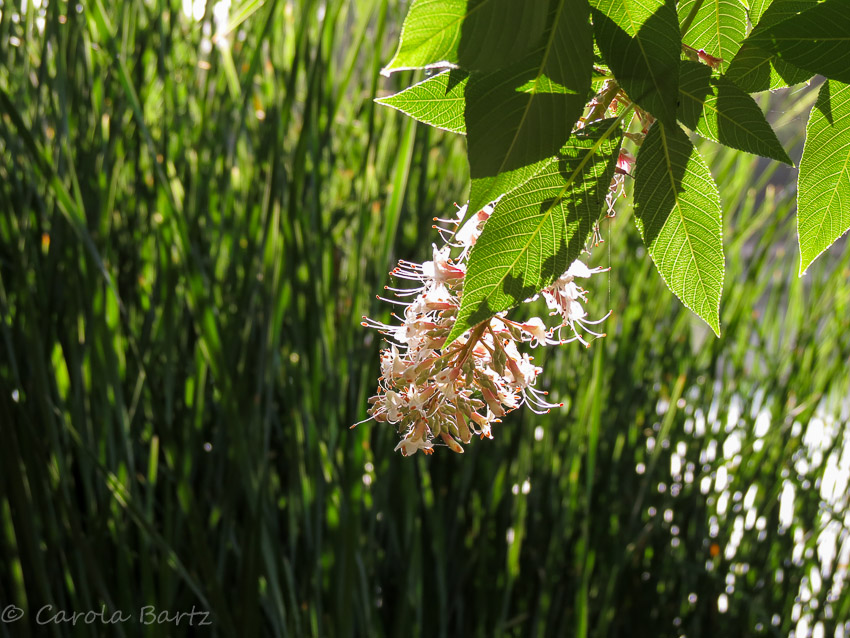
The California buckeye (Aesculus californica) is native to California and southwestern Oregon. Compared to its European relative it is rather short and almost has an umbrella shape. The flower spikes that appear in the spring after the leaves have emerged are white (with just a hint of light pink) with bright orange pollen. The entire tree is covered with these flowers and is quite a sight!


After the flowers are gone and we get into summer the tree does something remarkable: in order to survive the drought of the long summer months it drops all of its leaves and waits for the winter rain. However, the tree will develop its fruit in late summer that ripens in fall. It is sitting in a leathery capsule that hangs from the bare branches.


Slowly, those capsules will split open. I have read somewhere that this is the reason it was named "buckeye".


And then - in November the buckeyes will fall to the ground, either still sitting in the capsule...


... or popping right out of them. Their color is lighter than their European relatives, with reddish hues. It's a beautiful warm and earthy color, fitting for autumn.


The tree is poisonous in all its parts including the nuts. Some animals eat them if they don't find anything else, but usually they go unnoticed and just make new buckeye trees.

There are several buckeye trees at the lake and every autumn I check when the buckeyes will drop. This year they started to fall just last week. I gathered up three of them to bring home and use for decoration; the rest I left where they dropped. However, whenever I am at the lake I take a short detour to check how many more have fallen.