Showing posts with label München. Show all posts

Wednesday, November 8, 2023

Let's Hop on a Train


This week Rain's optional prompt for her Thursday Art and Dinner Date is "trains".

How I miss trains! In Germany it is so easy to take the train and get to other places, whether they are close by or far away. They are a joy to ride since you don't have to pay attention to traffic; instead you can read a book, listen to music, sleep or look out of the window and, if you feel like it, wave to the people in cars being stuck in a traffic jam while you zip along.

When we were in München (Munich) last year in May we rode the trains almost every day. München has an excellent public transportation system of busses, trams, subway, S-Bahn that connects to towns and villages within the vicinity of the city and, of course, the Regionalbahn (connection to other towns and cities further away) and the rapid ICE (Intercity Express).

If you land at the airport of the Bavarian capital, the S-Bahn is the fastest way to get to downtown München (Marienplatz). It's affordable, clean and fast.

I wish we had something like this from here to San Francisco and Oakland Airports. The only thing we have is the "train to nowhere" that doesn't even get you into San Francisco (you can get to Larkspur from where you walk for 15 minutes to get to the ferry terminal from where you take the ferry to San Francisco; the whole trip takes 2 to 3 times as long as driving in a car via 101 and the Golden Gate Bridge).

The S-Bahn is red - here you can see it standing in a station on the way to Ammersee. 

Another very fast way of transportation is the subway, just as clean as the S-Bahn. They often share the same stations.

The ICE is the "jewel in the crown" - a very fast train that connects the main big cities with each other. When we went from München to Würzburg for the Bartz Family renunion we took the ICE. It's very comfortable, quiet and, of course, very fast - they can reach a speed of 300 km/h. In test runs the first ICE even reached 406.9 km/h. I'm a big fan of the ICE, however, they are more expensive and, like all the other trains currently in Germany, not always on time. But if you have the "Deutsche Bahn" app, you get all the information you need - the exact time of the delay, your alternatives should you need one, which platform the train leaves/arrives, what and where your connection is etc. It is really convenient, but not perfect.

When we returned to München from Würzburg we took the Regionalzug which is much slower since it stops at more places. But it's also less expensive and often has great offers. It doesn't always have a direct connection to the place you want to go to and you might have to change trains in between, but it's still a great way to travel. Here you can see the Geek and I on the upper deck of the Regionalzug (yes, they often have two decks). This is also for Nicole's Friday Face Off.

I wish we had an efficient railroad system across the United States. It would be so lovely if I could just hop on a train to visit my close friend Jo in Portland, OR. But instead I either have to drive and spend the night somewhere on the road or, even worse, I have to take the plane.

Before I finish this, I want to introduce you to a very special train that helds big importance for Germany's newer history. In early fall of 1989, many people of the DDR (German Democratic Republic or East Germany), especially younger ones, went to Prague and sought asylum in the West German embassy there. DDR citizens usually were not allowed to travel to any Western countries (it was extremely difficult), but they could travel to Eastern European countries like Czechoslovakia (as it was still called at that time), Hungary or Romania. At the end of September there were more than 2,500 people in the embassy (can you imagine that?). Then foreign minister Hans-Dietrich Genscher, after many diplomatic talks and visits, went to the embassy and on the evening of September 30th he stepped out on the balcony and told the German people of the DDR that they can leave for West Germany. This moment still makes me cry, even after 34 years. For those of you who are interested in it, you can see it here (it's only 42 seconds). However, there was a hitch to it - the train with the DDR citizens on board had to go through the area of the DDR. This train was called "Zug in die Freiheit" (train to freedom) and there is a very good movie about it, a mix of documentary and scenes re-enacted by actors. I have seen this movie many times and I can highly recommend it. Here it is available with English subtitles.

40 days later, on November 9th, 1989 the Berlin Wall fell.

Finally - dinner! A couple months ago I "discovered" Korean beefless Bulgogi at Trader Joe's after another customer had recommended it. Both the Geek and I like it - we use it as a meatless substitute for beef in our meals. It is delicious. I use it in Asian dishes that I prepare in my wok as well as in pasta dishes. Recently I made it with "veggie" radiatori (also from TJ's) and fresh broccoli and carrots from the farmers market.


Saturday, July 30, 2022

What's Wrong with that Beer?


I know I know, you have been waiting for this, haven't you? You were starting to ask, when is she finally taking us to the beer garden? She has been writing about München since the beginning of June, but what about the beer??? And what was wrong with that picture in last Tuesday's T post?

Alright then, let's go to the beer garden.

In München you can pretty much go to a different beer garden every day if you want to. There are the big ones by the breweries like Paulaner, but there are also many smaller ones, some really just a bigger garden by the side of the road. 

Beer gardens have long simple tables and benches. Sometimes, when the place is very crowded, you share the table with strangers - a great way to meet and get to know other people. The majority of German beer gardens are in Bavaria, and other than beer gardens in the rest of Germany, you can bring your own food and eat it there as long as you buy your drink(s). We've seen many people who do this - they buy their beer (or whatever they want to drink) and at the table they put out their tupperware and spread their food. It's a great way to spend the evening outside in company without breaking the bank.

Our first evening in Munich, finally spending time with Kaefer again

Of course you can also order food in a beer garden. The food is typical Bavarian dishes and is served cafeteria style.


Kaiserschmarrn, Schnitzel, Weißbier and dunkles Weißbier

Breze, Obatzda (Bavarian soft cheese dish), Radi (radish), Kartoffelsalat (potato salad)

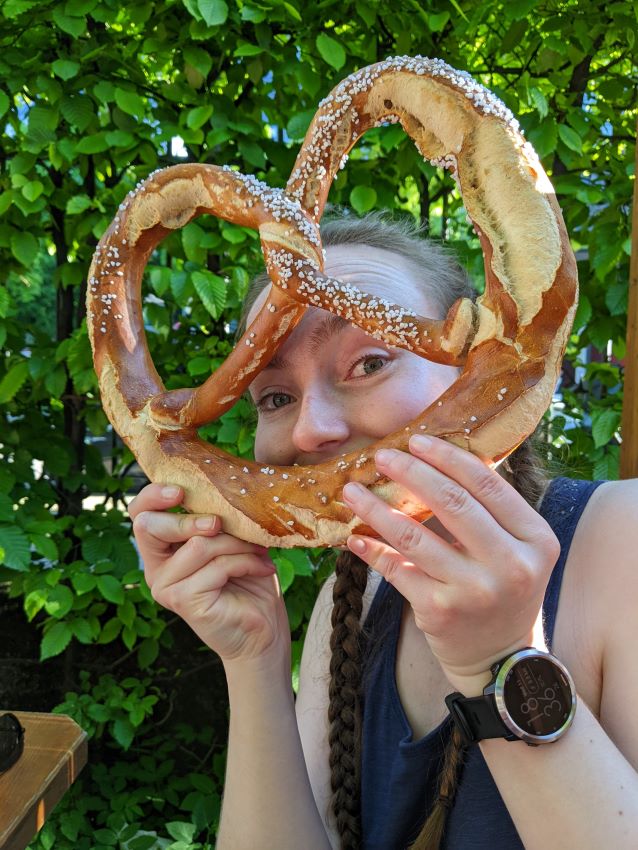
Pretzels are always on offer and they can be very big.


She can be such a goofball!

Weißbier, especially the dark one, is my favorite. It is also often called Hefeweizen and is more popular in the South and Southwest than in the rest of Germany.


Weißbier is served in a special glass that is only used for Weißbier / Hefeweizen. 


A "regular" beer - called "Helles" (light - as in light color) or "Dunkles" (dark) - comes in glasses like this or smaller ones:


But what is "regular" beer anyway? There are so many different kinds of beer in Germany, some are more popular in the areas where they come from. "Kölsch", a very light, top-fermented brew comes from Köln (Cologne); "Alt" (old) is a top-fermented, dark bitter brew from Düsseldorf and very popular in Westphalia; Pilsner or Pils is popular all over Germany, it is bitterer than most beers and must be carefully drawn - usually seven minutes (if you order a Pils and you get it after three minutes, it is not carefully drawn); "Rauchbier" (smoked beer) that is brewed in Bamberg. These are just a few kinds of beers of the rich selection in Germany. And each has its own glass.

Glasses for Weißbier, Kölsch and "Willibecher", a more universal glass 


Glasses for Pils, Alt and the famous Bierseidel which comes in 1 or 1/2 liter

You might have heard about the German Reinheitsgebot (purity law), enacted in 1516 in Bavaria's Ingolstadt. It says that "from henceforth, in our towns, our markets, and in the country, nothing should be used in the making of beer except barley, hops, and water alone." Yeast as an ingredient was added later. In 1987 this ruling was reversed when German brewers lost their case that brewers from countries outside Germany should not be allowed to import any beer if it wasn't brewed according to the Reinheitsgebot. However, brewing beer by only using barley, hops, water and yeast enjoys very high popularity in Germany and brewers proudly announce that their beer is "pure". Weißbier is brewed with a large proportion of wheat relative to the amount of malted barley.

German beer "science" doesn't end here. Remember the picture I showed last Tuesday, mentioning that something is wrong here?


When you go out with friends or a group, before you take your first sip of beer you clink glasses. While you clink glasses, you don't look at your glass, but you look into the eyes of the person you clink glasses with. It is very rude not to do that. So far so good. Looking at the picture above, you would think that this looks alright - we're clinking glasses, Kaefer is looking at me... but no. We're not drinking any old kind of beer, we're drinking Weißbier. And with Weißbier, you clink with the BOTTOM of the glasses, not the top as in the picture. This is ONLY for Weißbier, not for any other drink. Why? By clinking the glasses at the bottom, the yeast that has settled at the bottom after pouring is being "shaken up" and distributes throughout the drink. If you happen to pour Weißbier from a bottle, you have to do it very slowly with the glass held almost horizontally, otherwise you get too much foam at the top. Before the bottle is completely empty, you "shake" it in a circular movement so that you get all the yeast at the bottom. I told you it's science! I once even did a Weißbier pouring session at my home with my German class - it was very popular. The fun of teaching adult students!

By the way, we did clink our glasses at the bottom after taking this picture!

Elizabeth, thank you for the opportunity to share this with the T Tuesday gang. Everybody knows now what to do if they find themselves in Germany with some Weißbier (or in a German restaurant outside of Germany).

This has become quite long... so let's lean back and have a beer. Prost!


Monday, July 18, 2022

T is for AlTer PeTer


The view from a tower is always a great way to see a city from above and get some orientation. While we were in München, Kaefer suggested climbing the tower of St. Peter, the oldest recorded parish church in Munich, right in the center of the city. It is called "Alter Peter" in the vernacular. You can find it between Marienplatz and Viktualienmark.

Climbing the tower is not for the faint of heart - it's up old wooden stairs and after a while I stopped counting the steps and just concentrated on actually making it to the top. I had to take a few breaks and catch my breath, but I eventually made it to the viewing platform.

It was worth every single step (and every silent curse that slipped through my mind). What a view!

View over Heiliggeistkirche toward Kaefer's neighborhood at the horizon

Neues Rathaus (New City hall) at Marienplatz, Theatinerkirche and Hofgarten; Olympic Tower to the left

Frauenkirche - one of the most well known landmarks - and Olympic Tower

Viktualienmarkt - you can even faintly see the Alps in the distance

Looking straight down to the roof of the church - it is a very long church.

After we had come down we visited the inside of the church. It is Roman-Catholic like so many churches in Bavaria. It's built and decorated in the Baroque style, lots of gold inside - let me put it mildly, I simply don't like it (those who know me are aware of my much stronger feelings and opinions).


I couldn't resist taking the following photo, even though the quality is rather poor. My photographer's eye is always open, even if I don't like a place (or especially then).

One thing I like in Catholic churches are the candles and I always light one for my family. In my book, praying for your family is not dependent on any church or even religion. I liked that the image of the church is engraved on the candles.


Pandemic times didn't pass by the holy water either - it was in a special dispenser ("Weihwasserspender" means holy water dispenser).


Right next to the church are several street cafés and we thought it was time for a break - and this is my ticket for Elizabeth's T Tuesday. Kaefer and I had a Bellini with a scoop of ice cream and the Geek opted for the ice coffee. Please note that I write "ice" instead of "iced" coffee - ice coffee is cold coffee with one or two scoops of vanilla ice cream and often whipped cream on top. It's very popular in Germany; the German word for it is "Eiskaffee" (and the same goes for Eisschokolade or ice chocolate that I wrote about here).


I simply love the reflection of the Bellini in Kaefer's sunglasses.


Monday, July 11, 2022

Walk Along the River


The river that runs through München is called Isar. It is 295 km long and has its source in the Karwendel range of the Alps in Tirol, Austria. Its longest distance is in Bavaria where it eventually flows into the Donau (Danube). The river is not navigable for watercraft above raft size (no cruise ships, yay!)

Kaefer loves the Isar. She often runs there or takes her bike and her swimsuit and spends a couple hours on the banks of the river and swims in the river in the summer. She took us on a walk there.

We started at the Friedensengel (Angel of Peace)


The Friedensengel is a monument that is part of the Maximilian-Anlagen (Maximilian Park) and the foundation stone was laid in 1896. It is a reminder of the 25 peaceful years after the Franco-German war of 1870/71. The Friedensengel sits on top of a beautiful fountain.


From here we walked beside the river, along boardwalks and soft forest trails.


I liked the big concrete balls along the boardwalk.


You have certainly noticed all the graffiti on the surfaces. Some of them are quite impressive, some not so much. Here are two I liked.


On the forested path I noticed the flowering Laburnum and couldn't resist taking a few pictures of Kaefer in front of it. We enjoyed watching the ping-pong players - you often find ping-pong tables in public parks in Germany, you only have to bring your own paddle and ball.


We stopped at Kabelsteg where  we had a beautiful view of St. Lukas with a rather dramatic sky (there had been a thunderstorm shortly before we started out for our walk) and when I turned around, the view down the river toward Maximilanbrücke (the bridge you can see ) was just as beautiful.


We walked further up the river, passed the Deutsche Museum, one of the most interesting museums, especially if you're interested in science and how things work, and finally reached the meadows that are popular with the locals for meeting friends and familiy to spend a lovely evening, barbeque or just hang out.


Last week, Kate asked how I make the Karkade that I showed you as my drink (and will do so today as well). I don't follow a special recipe, so here goes:

Add 2-3 tablespoons of dried hibiscus flowers to a big pot. Bring 1 liter (or a bit more than 4 cups) of water to a boil and pour over the hibiscus flowers. Cover and let steep overnight. The next morning, pour it through a sieve into another pot. Add sugar to taste - I don't like it too sweet. Stir and put in the fridge for a couple hours. Enjoy. 

I'm actually having a glass while I'm writing this, since I didn't drink all of it during my lunch of falafel and tomatoes.


This wonderful summer drink is my ticket to Elizabeth's T Tuesday.