Showing posts with label drought tolerant garden. Show all posts

Monday, July 31, 2023

Picnic in the Vineyards


Last Friday the Geek and I met with our friends P and B for a lovely picnic in the vineyards. We had thought about that for quite some time and finally we could settle on a date that worked for all of us. We chose to go to Navarro Vineyards in the beautiful Anderson Valley.


Navarro Vineyards is a family owned small winery that has been making wine since 1974. Most of their wines is not available in stores, but can be  purchased directly in their tasting room or through their website. We have been drinking their wines for several years now and we have yet to find a wine of theirs that we don't like. The winery is located in Anderson Valley in Mendocino County, away from the crowded Wine Country hype in Sonoma and Napa Counties. This results in no tasting fee, more affordable wines and less crowds, so reservations are not required. There is ample space to sit and sip some wine or have a decent picnic with a bottle or two of their wine that can be purchased in the tasting room.


We had our picnic right at the edge of the vineyards under the wisteria cover.


Our table was covered with a lot of tasty food that the four of us had brought from home.


I had baked a whole wheat bread, which was delicious with red pepper aioli and smoked ham.


You can see that we had a wonderful time!


Let's see what kind of drinks we can find for Bleubeard and Elizabeth's T Tuesday: a bottle of Rosé of Grenache, a bottle of Pinot Gris, several re-usable bottles of water and grapefruit juice and a glass bottle of Gerolsteiner sparkling water (I simply refuse to buy sparkling water in plastic bottles which leaves only German and French sparkling water). The food we had included meatballs, smoked salmon, several cheeses, bread, red pepper aioli, tuna bowl, chocolate and vanilla pudding, blueberries, peaches and tomatoes from my garden. It was a feast!


Navarro not only has vineyards, but also beautiful gardens with mainly drought-tolerant or native plants. I found some inspiration for my garden. Roses right next to a vineyard is something you see often here.


We stayed in the vineyards for three and a half hours. We decided to drive back along the coast, via Highway 1 - THE ONE, as my husband would say. It certainly is THE ONE for us - one of the most beautiful roads that hugs the California Coast in an often spectacular way.


We stopped at Point Arena Lighthouse, at 115 ft (35 m) the tallest lighthouse on the west coast of the US. It is also the closest location in the lower 48 to Hawai'i at a distance of about 2,350 miles (3780 km) (you always wanted to know that, right?). The first Point Arena Lighthouse was constructed in 1870, but was damaged in the Great Earthquake of April 18, 1906. The current lighthouse that is built to withstand earthquakes began operation on September 15, 1908. It features a 1st Order Fresnel Lens (built in France) that is made up of 258 hand-ground glass prisms. These prisms are all focused toward three sets of double bulls eyes which gave the lighthouse its unique light "signature" of two flashes every six seconds (that was before the installation of an automated aircraft-type beacon on the tower balcony in June 1977). This is probably more information than you ever wanted...


This is a very windy, often cold location, but oh! so beautiful. I never get tired of it, and I have been here many times in the past 22 years. The geology is interesting and just like at Salt Point, I wish I knew more about it. The Coast Buckwheat (Eriogonum latifolium), a California native, is found in abundance here.


This is also close to where the infamous San Andreas Fault (the bad boy of 1906) dips into the ocean.


I leave you with a last picture of the lighthouse and the interesting fence that was built just a few years ago. Before that, there was a white picket fence. For this fence, older growth mica schist hand split flagstone material from the Mojave desert was used. From a distance it looks like wood, but as you apporach it looks more like a thick jagged stone wall.


May a light shine throughout your week.


Monday, July 3, 2023

The June Garden


June has been rather strange this year. We had a lot of June gloom and sometimes the sun wouldn't make an appearance before the late afternoon. Temperatures were lower than normal and when I compare the state of the garden to photos that I took around the same time last year, I can see that everything is about two weeks behind.

Nevertheless, it was a great month in the garden.

The poppies were still going strong as well as the yarrow "Moonshine" (Achillea). The terracotta yarrow had started to bloom toward the end of the month.


The pineapple guava (Acca sellowiana) was blooming in abundance and there was the steady quite loud humming of bumblebees in the air. They sure had a blast! The flowers are loved by some birds as well, especially Northern Mockingbird and California scrub jay, and the squirrels won't avoid them either.


The hollyhocks (Alcea) are my guilty pleasure. They don't really belong into a California garden, but they remind me of England and therefore I have a few. Since we had so much rain in the winter, they are doing particularly well this year. They don't get a lot of additional water from me.


This lavatera was a surprise for me. A few years ago I had a big pink flowering lavatera that eventually was not doing well and I had to remove it. I thought I had removed all of it, but obviously this one got away and started blooming this year right next to the desert globe mallow (Sphaeralcea ambigua). The desert globe mallow has spread quite a bit. I first saw this flower in Arizona where it was happily blooming in the company of California poppies and saguaros. So I knew that it doesn't need much water. When I discovered it in one of my two favorite nurseries, I was thrilled and gave it a try. It is doing exceptionally well and never fails to bring a smile on my face.


The Matilija Poppies (Romneya coulteri) were doing well in front of the Smoketree (Cotinus). I love how beautiful these two plants look together.


This year I have way more insects in my garden, but unfortunately so far I wasn't able to take pictures of them all. There are ladybeetles everywhere, but I also saw soldier beetles who devour a great deal of aphids. There are tiny spiders as well as other little bugs that I still need to identify. I was happy to see the Fiery skipper on the yarrow and finally captured a Flame skimmer when he was resting on this thin branch.


Verbena bonariensis is one of my favorites. It is such a workhorse in the garden - it is tall, but doesn't obstruct any view so you can plant it even at the front of other plants. It is drought tolerant, self sows and attracts many pollinators. It thrives on neglect and flowers for a very long time.

The Centaurea I first saw in a neighbor's garden and it took a while until I actually knew what kind of plant it is. I was so surprised when I discovered it in the nursery (the same one that had the desert globe mallow) and took three of them home. Once they are established they are supposed to be very drought tolerant. I love the silver foliage.


There are Shasta daisies (Leucanthemum x superbum) in the "kitchen garden" (the part of the garden in front of my kitchen window), sweet pea (Lathyrus odoratus) in the back corner, and salvias throughout the garden. The hummingbird sage (Salvia spathacea) is a California native and has wonderful scented foliage. My only dahlia started to flower at the end of the month (I keep it in part shade) and so did the hebe.


These three are some of my most beloved favorites, all of them California natives - Coyote mint (Monardella villosa 'Russian River'), Vitis 'Roger's Red' and red flowered Buckwheat (Eriogonum grande var. rubescens). I have several other buckwheats, but the other ones are not flowering yet.


Of course I shouldn't forget the permanent resident in the garden, The One Who Rules Them All, resting under the Vitex agnus-castus.


My garden is my happy place. I work here a lot - there is always something to do - but it is a good and very satisfying kind of work. I'm still changing up a lot, but it sure is on its way to become a habitat garden.

Here is another picture of the "kitchen garden" with different kinds of salvia. The tall lavender colored one is clary sage, Salvia sclarea - very drought tolerant, self sows and a big pollinator plant.


We need a drink since this is for Bleubeard and Elizabeth's T Tuesday and a post that doesn't show anything to drink is not allowed. Since we're in the garden, let's have a fruity "garden drink" - Riesling with strawberries. Not quite like a German Erdbeerbowle (drunk strawberries) - we will have that this coming weekend.


Monday, June 7, 2021

Saving Water


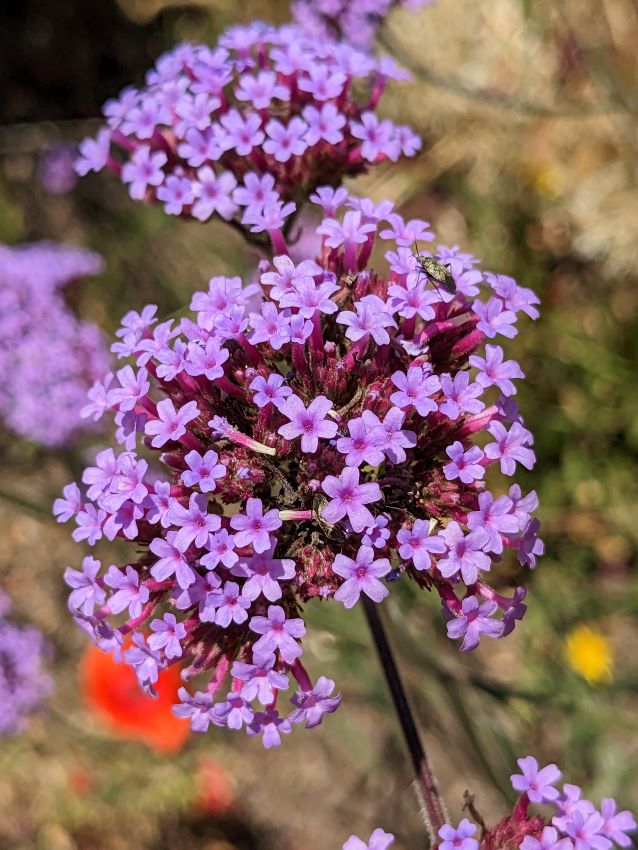
The plant in the photo above - Verbena bonariensis - is a tough work horse in the flower garden - beautiful, colorful and very drought tolerant. This is exactly what we need here in Northern California if we want to have beautiful gardens while saving water at the same time.

This year saving water is more important and urgent than ever. We are in an exceptional drought - "exceptional" being the most severe level of drought. Our last drought ended a couple years back with record rain falls, one "atmospheric river" chasing another. That drought "only" was labled as "severe".  But now we are in the "exceptional" stage and I'm wondering why our county supervisors and city council members aren't demanding mandatory restrictions. It's not like this situation is going to change to the better anytime soon since there won't be any significant rainfall before November (if even then).


We get most of our rainfall in the winter. Our 30-year annual average is 34 inches; this year, however, we only received 12.86 inches which is 39% of the average. Our main reservoir, Lake Sonoma, is at 56.5% of capacity. 

For now, residents are asked to restrict their water use voluntarily by 20%. I'm pretty sure with summer not even having started, those restrictios will eventually become mandatory.

Our household uses 2000 gallons of water on average in a month. In the summer it can reach 3000 gallons and very seldom even 4000. With these numbers we are far below the average of a "normal" household and it's getting harder and harder to save additional water since we are already pretty water savvy.

These guys are my best friends when it comes to saving water:


We use flexitubs everywhere in the garden, but their main purpose is catching the water in the shower while it heats up (of course we have low water fixtures).


Outside I have a water barrel where I store any water that I can catch.


Whenever my watering cans are empty I refill them from the barrel. And here you can see how serious I am about saving water (I guess that's the German in me!) - the barrel is leaking at the tube when I open the valve, so I put a bowl beneath it where I catch that water. Not a drop gets unused!


In the kitchen sink I have another bowl where I catch any water - when I wash veggies or the water after I have boiled eggs. Sometimes I even drain the pasta water in here and water a few plants with that - and those plants seem to like the starchy water.


So what about the garden? you might ask. First, I hand water my garden. I have a couple long hoses that I put to work about once a week, twice if it is very hot. Only the vegetables are watered more often than that - but I only have one raised bed with tomatoes, zucchini and some basils. I cut back a lot this year.


With a very few exceptions my garden is filled with drought tolerant plants. I use California natives a lot, but also plants that are native to Australia and the Cape region of South Africa. I eventually will introduce more succulents to the garden. 

A drought tolerant garden does not have to be boring, but can be very colorful.


It really depends on having the right plants in your garden. An English cottage garden certainly is not the right choice.

Clockwise from top left: Lavandula stoechas (Spanish lavender), Salvia nemorosa (Woodland sage), Salvia sclarea (clary sage), Echinacea purpurea (Purple coneflower) and Calamintha nepeta (Lesser calamint)
From left to right: Romneya coulteri (Matilija poppy), Sphaeralcea incana (Soft globemallow) and Achillea 'Moonshine' (Yarrow)

We don't have a graywater system (even though that probably would be a great idea). If you have any more ideas how to save water, please let us know in the comments.