September had hardly begun when it was already over - at least that's how it felt. It was a busy month.
Advent, those four weeks before Christmas, are a very special time in Germany. In many cities and towns, Christmas markets open their booths, many of them being a part of the place for several weeks.
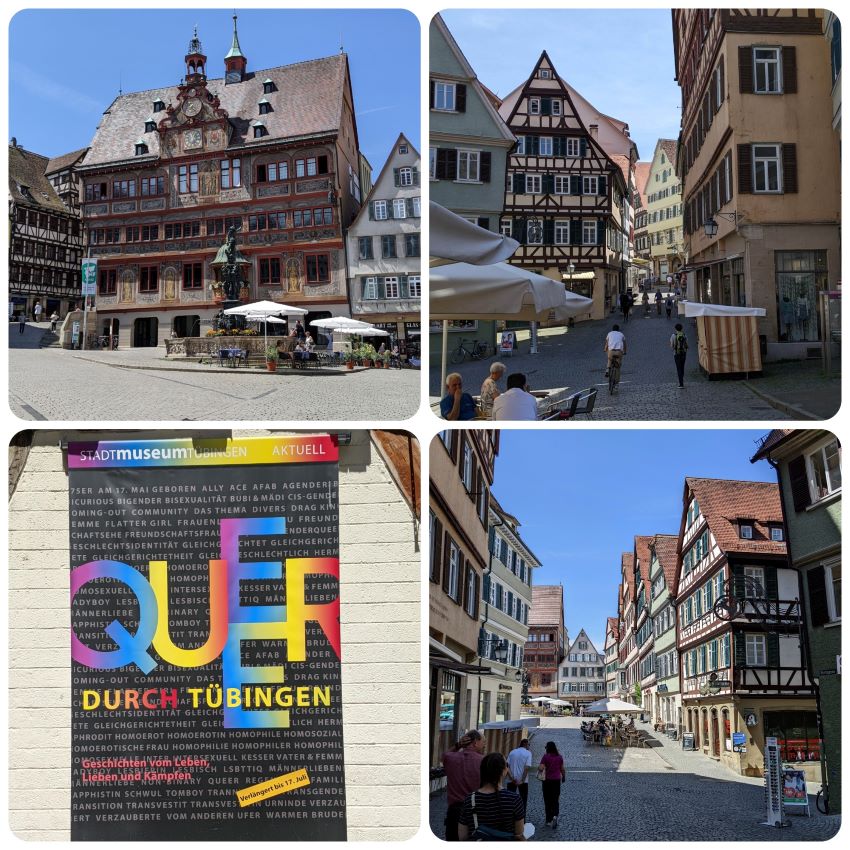
I remember the third Advent-weekend in December back in Tübingen, Germany, where I spent more than twenty years of my life. It's a medieval university town with its typical old buildings that look like they're straight out of a fairy tale by the Grimm Brothers. Narrow lanes wind among medieval timber-framed houses and cars are not allowed within the city center. It's a huge pedestrian zone that makes wandering the old alleys so peaceful.
This is the setting for one of the most beautiful traditions of the town: the Christmas Market. It's nothing like its big siblings in Nürnberg, Stuttgart or München and so many other cities. First, it only takes place from Friday to Sunday and not weeks and weeks and weeks. Second, it's not commercial. There are tons of local artists who sell their work, school classes who raise funds for their annual end-of-the-year trip, small local environmental groups who fight for preservation, neighborhoods who try to raise awareness and money for people with disabilities - the list could go on and on.
So that's the eye-candy. The next is the food - just one word: delicious. The food is mainly local specialities, the best time to eat "Bubaspitzle mit Sauerkraut" (a thin rolled kind of potato pasta with sauerkraut and sometimes bacon), one of my fondest memories in the food department. There was a guy with a complicated portable special oven who made Swiss Raclette that was to die for. Of course there was Glühwein (mulled wine), very welcome in the cold. None of the food or the drink was allowed in any kind of plastic or paper container, everything had to be re-usable! Most of the plates were eatable - envision big sturdy waffles for apple strudel! No trash! You bought a beautiful mug with the words "Tübinger Weihnachtsmarkt" written on it and this could be refilled at any booth that offered Glühwein or juice punch. I still have a few of these mugs, pictured below, and they are this week’s ticket to Bleubeard and Elizabeth’s T Tuesday.
Throughout the market you could listen to music. Children were singing, little choirs stood at the fountain in the market square, someone played the violin, another one the bagpipe, and again another one the flute. There was a cantata concert in the main church. There were jugglers and clowns. It was a very festive atmosphere.
And of course there was “Paupersingen”. The Paupersingen (paupers singing) is a tradition that originated in the Middle Ages. "pauper" is a Latin word and means poor, and in this case it refers to poor students of Latin who paid part of their school fee by singing during church services and at funerals. During Advent they wandered through the narrow lanes of the town, wearing their black scholar cloaks and singing in front of every house, hoping for some donations.
Today it's the children choirs who start out at different parts of Tübingen and slowly, with several stops in between, walk to the market square, all the way singing the old Christmas carols. They all meet at the huge Christmas tree where all of them together sing for another half hour or so. The donations today go to some charity of their choice. (I apologize for the very unfocused photo.)
We felt like community, we were community. People spending three days in the cold in order to help someone else. To serve others. To share stories. To entertain children and their stressed parents. To bring smiles on the cold faces, red cheeks from the mulled wine.
That third weekend in December was spent in the streets among those medieval buildings, no matter whether the sun was shining, it was raining or snowing. It was freezing cold - always. But everyone was there. Community.
(This is the slightly edited version of a post that I first wrote for Vision and Verb in 2010 or 2011.)
After nine days in Munich, we left the city for our mini road trip during which we crossed into several European countries. Our first destination was Alsace where we planned to spend a few days. On our way there we decided to stop for lunch in Tübingen, my old stomping grounds.
I moved to Tübingen after I had graduated from high school in order to study at the university. Tübingen is a mediaval town with narrow alleys and hidden corners, all of which I got to know and love so well during the 22 years I lived there. I was very lucky that pretty soon after graduating with a master's degree I found a job in a town nearby. I commuted for many years because I simply didn't want to leave Tübingen. Coming back after so many years to a town that will always have a special place in my heart was a bit weird - and interesting. The routing of streets was as odd as it was more than 20 years ago and thus felt very familiar. Some well-loved pubs and restaurants weren't there any longer; in their place I saw modern shops that no one seemd to visit. One of the restaurants where I used to spend many lovely times was still operating and this is where we had our lunch.
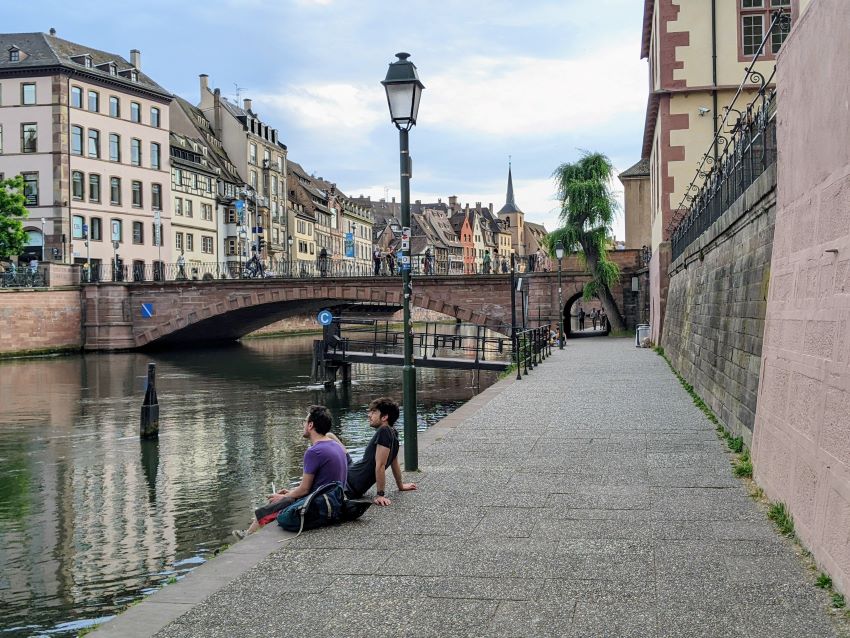
Through the Black Forest we made it to Strasbourg where we first checked in our hotel that we had booked some time during the day and then took the tram to the city center. Other than in Munich where almost everyone wore masks in public transportation, France behaved like there never was a pandemic. Only a couple other people and ourselves were the only ones who wore masks in the rather crowded tram. Clearly, no one cared about COVID anymore. My daughter - the budding epidemiologist - was not impressed.
The famous cathedral is visible from almost everywhere.
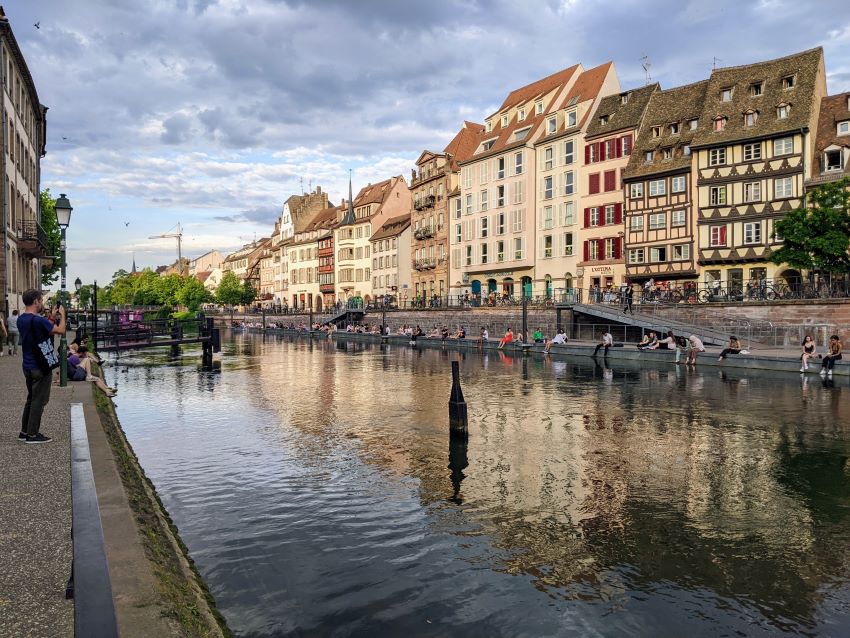
Strasbourg, located right on the border between Germany and France, is a cosmopolitan city through and through. It is the largest city of the Grand Est region of Eastern France and the official seat of the European Parliament. The most attractive part of course is the historic city center, the Grande Île (Large Island), which is a UNESCO World Heritage Site. As the name suggests, it is an island that is surrounded by the main channel of the Ill River on one side and by the Canal du Faux-Rempart on the other side. Strasbourg lies on the Rhine which is the bordering river between France and Germany.