I know I know, you have been waiting for this, haven't you? You were starting to ask, when is she finally taking us to the beer garden? She has been writing about München since the beginning of June, but what about the beer??? And what was wrong with that picture in last Tuesday's T post?
Alright then, let's go to the beer garden.
In München you can pretty much go to a different beer garden every day if you want to. There are the big ones by the breweries like Paulaner, but there are also many smaller ones, some really just a bigger garden by the side of the road.
Beer gardens have long simple tables and benches. Sometimes, when the place is very crowded, you share the table with strangers - a great way to meet and get to know other people. The majority of German beer gardens are in Bavaria, and other than beer gardens in the rest of Germany, you can bring your own food and eat it there as long as you buy your drink(s). We've seen many people who do this - they buy their beer (or whatever they want to drink) and at the table they put out their tupperware and spread their food. It's a great way to spend the evening outside in company without breaking the bank.
Our first evening in Munich, finally spending time with Kaefer again
Of course you can also order food in a beer garden. The food is typical Bavarian dishes and is served cafeteria style.
Kaiserschmarrn, Schnitzel, Weißbier and dunkles Weißbier
Breze, Obatzda (Bavarian soft cheese dish), Radi (radish), Kartoffelsalat (potato salad)
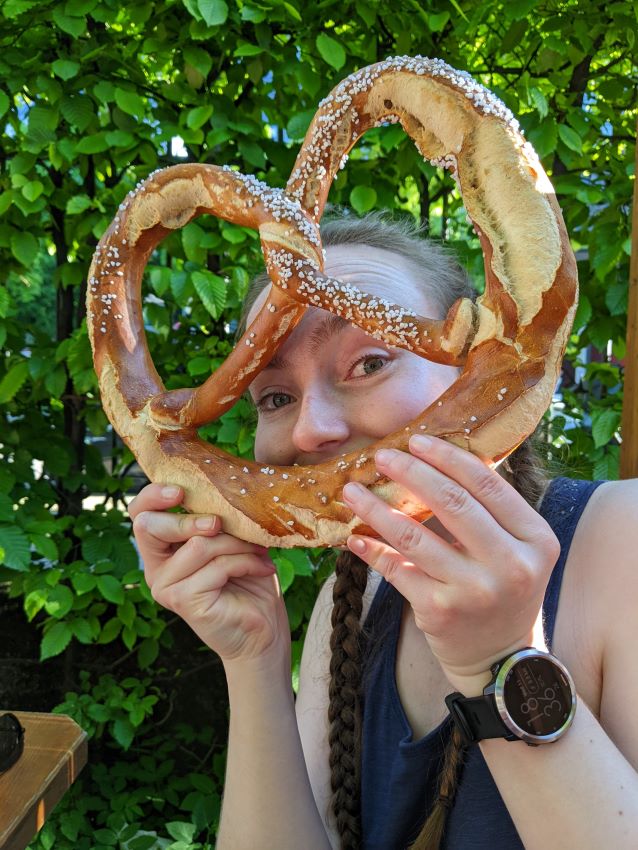
Pretzels are always on offer and they can be very big.
She can be such a goofball!
Weißbier, especially the dark one, is my favorite. It is also often called Hefeweizen and is more popular in the South and Southwest than in the rest of Germany.
Weißbier is served in a special glass that is only used for Weißbier / Hefeweizen.
A "regular" beer - called "Helles" (light - as in light color) or "Dunkles" (dark) - comes in glasses like this or smaller ones:
But what is "regular" beer anyway? There are so many different kinds of beer in Germany, some are more popular in the areas where they come from. "Kölsch", a very light, top-fermented brew comes from Köln (Cologne); "Alt" (old) is a top-fermented, dark bitter brew from Düsseldorf and very popular in Westphalia; Pilsner or Pils is popular all over Germany, it is bitterer than most beers and must be carefully drawn - usually seven minutes (if you order a Pils and you get it after three minutes, it is not carefully drawn); "Rauchbier" (smoked beer) that is brewed in Bamberg. These are just a few kinds of beers of the rich selection in Germany. And each has its own glass.
Glasses for Weißbier, Kölsch and "Willibecher", a more universal glass
Glasses for Pils, Alt and the famous Bierseidel which comes in 1 or 1/2 liter
You might have heard about the German Reinheitsgebot (purity law), enacted in 1516 in Bavaria's Ingolstadt. It says that "from henceforth, in our towns, our markets, and in the country, nothing should be used in the making of beer except barley, hops, and water alone." Yeast as an ingredient was added later. In 1987 this ruling was reversed when German brewers lost their case that brewers from countries outside Germany should not be allowed to import any beer if it wasn't brewed according to the Reinheitsgebot. However, brewing beer by only using barley, hops, water and yeast enjoys very high popularity in Germany and brewers proudly announce that their beer is "pure". Weißbier is brewed with a large proportion of wheat relative to the amount of malted barley.
German beer "science" doesn't end here. Remember the picture I showed last Tuesday, mentioning that something is wrong here?
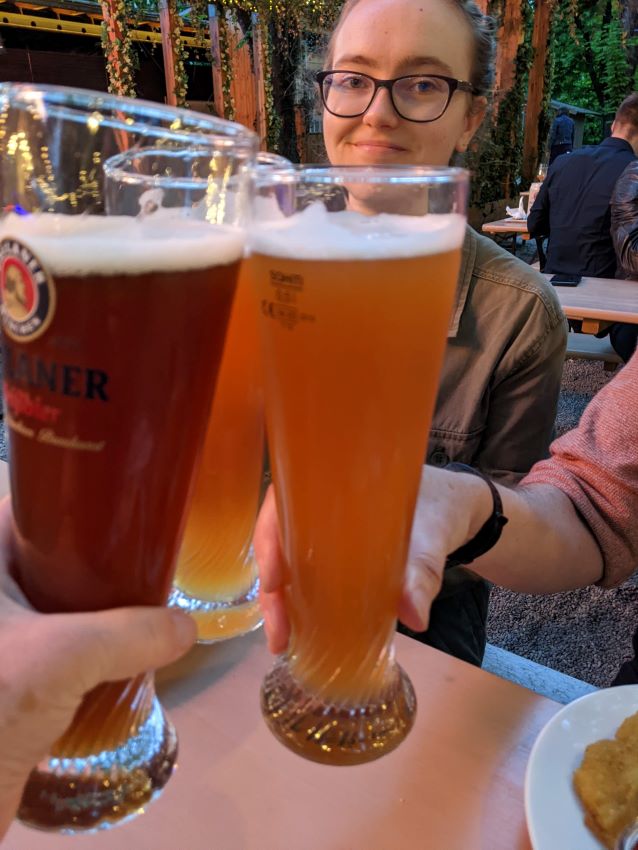
When you go out with friends or a group, before you take your first sip of beer you clink glasses. While you clink glasses, you don't look at your glass, but you look into the eyes of the person you clink glasses with. It is very rude not to do that. So far so good. Looking at the picture above, you would think that this looks alright - we're clinking glasses, Kaefer is looking at me... but no. We're not drinking any old kind of beer, we're drinking Weißbier. And with Weißbier, you clink with the BOTTOM of the glasses, not the top as in the picture. This is ONLY for Weißbier, not for any other drink. Why? By clinking the glasses at the bottom, the yeast that has settled at the bottom after pouring is being "shaken up" and distributes throughout the drink. If you happen to pour Weißbier from a bottle, you have to do it very slowly with the glass held almost horizontally, otherwise you get too much foam at the top. Before the bottle is completely empty, you "shake" it in a circular movement so that you get all the yeast at the bottom. I told you it's science! I once even did a Weißbier pouring session at my home with my German class - it was very popular. The fun of teaching adult students!
By the way, we did clink our glasses at the bottom after taking this picture!
Elizabeth, thank you for the opportunity to share this with the T Tuesday gang. Everybody knows now what to do if they find themselves in Germany with some Weißbier (or in a German restaurant outside of Germany).
This has become quite long... so let's lean back and have a beer. Prost!