
When we first went to Bowling Ball Beach it was during a low tide. But then we learned that there was a zero tide two days later at 5:38 in the morning. While scrambling down the cliff in the dark wasn't really appealing, nothing could keep us in our little cabin.
When we left, it was pitch dark and there was no one else driving along Highway 1. We arrived at the parking spot a bit more than 10 minutes later and started our walk toward the beach along the same path we took two days earlier. It was a clear morning with no marine layer which is rather unusual for our coast. Above us we saw a magnificent starry sky. Our flashlights helped us going down the difficult part of the cliff, but then the walking was easy on the beach until we reached the big boulders.
When we arrived it looked like this

but looking south we already saw the day dawning.

We lit up some of the "bowling balls" with our flashlights and took a couple photos in that light just for fun.


In all my photos you will notice different quality of light. This is because some of the pictures have been taken with my DSLR and some with my phone. The phone camera is more light sensitive than the DSLR (except if I crank up the ISO at the expense of the quality of the photo), but the mood is different. You can easily tell which photos were taken with which camera - the lighter ones are the phone pictures and the more atmospheric ones are the DSLR photos.
In reality it wasn't quite as light as in this picture. The phone picture does an excellent job in picking up light, but unfortunately at the expense of mood.

While the Geek was setting up his equipment, I turned my view (and lens) to the ground and explored all the tiny tidepools.


I think these tiny green fish might be Tidepool Sculpins (Oligocottus maculosus) and I'm pretty sure that the black snails are Black Tegula (Tegula funebralis) since they are so abundant on the West Coast. The lighter ones might be Checkered Periwnkle (Littorina Scultulata), another abundant snail on our shores. You can also see sea anemones.
The light changed constantly and the sky displayed a tender pink glow.

It was time to take pictures of the bowling balls before the tide would come back in.


I wrote about the ruts in my previous "Bowling Ball" post. As you can see, they were covered with seaweed and algae and it was really difficult to walk on them since they were very slippery. Even my hiking boots couldn't always find a secure footing.

Since the boulders are covered with salty water most of the time, they were covered with seaweed and algae as well. Most of them had a bad hair day.


When I looked up, the light had changed again. Looking toward northwest:

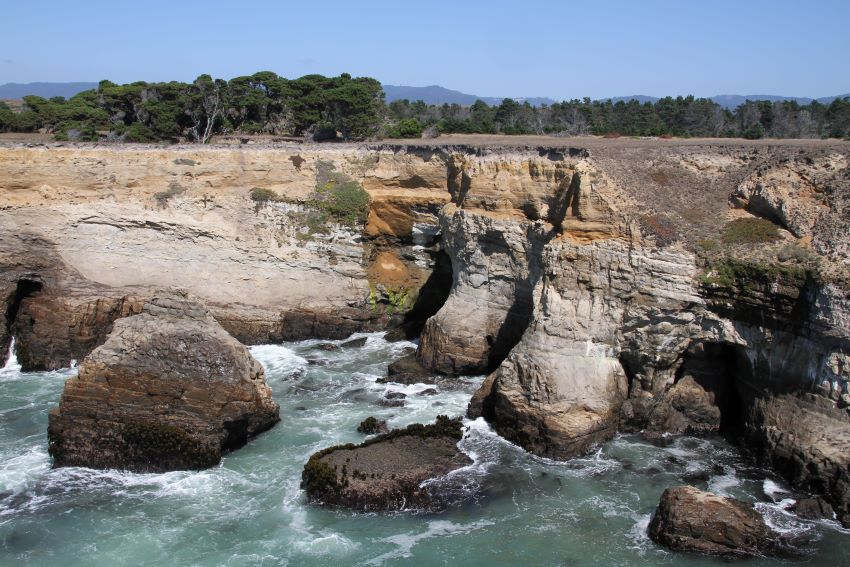
I decided that I had taken enough pictures of the boulders and focussed now on the beautiful views around me.
To the south the light became more dramatic and I loved the reflection in the water.

The reflection of the cliffs and the trees on top were stunning, too.

Of course I had to take photos of the gulls - how could I not?

.jpg)

Looking down, I noticed the different texture of the sand.

Then it was time to slowly walk back. By now it was an hour after the lowest point of the zero tide and we noticed the water coming in again. While walking back I still had my eyes trained on the sand and the ocean (you never leave your eyes off the ocean while on the beach anyway - that's a lesson you learn very quickly when you live near the coast). This read algae, Callophyllis, I often see on our beaches. Fun fact: Callophyllis is commonly known as carola.

Of course there was a rock cairn as well. They almost always are.

Looking back we saw the sun touching the cliffs in the north, those that were reaching out into the ocean.

The Geek while walking up the path, and a look back toward the beach.


When I looked down, I could clearly see the ruts disappearing in the water. We hadn't seen this the last time when the tide was much higher.

When we reached the top of the cliffs, the sun touched the trees. It was such a lovely morning.

I leave you here with a few more atmospheric photos of the ocean.


It was such a wonderful start of a new day.

I will take a break from blogging for a few weeks. I hope all of you have a lovely, colorful autumn or joyous spring depending where in the world you are, and I will "see" you again in November or December.


.jpg)




.JPG)


.JPG)


