Showing posts with label lava. Show all posts
Friday, June 22, 2018
Memories of A Lost Land
Back in March I wrote about the Puna District on the Big Island of Hawai'i that I love so much. The last time we had been there was in January - and had I known that it literally would be the last time that I'd see it this way I probably would have taken way more photos than I actually did. But the memories of this now lost land are in my heart and it's where they will stay.
A big part of Puna has changed forever and is still changing every day. While it comes as no surprise that an active volcano would behave - well, actively - it is still heart breaking. Having your home being consumed by lava that creeps into your backyard is simply terrible. Even though the people had enough time to save a lot of their things, their homes are lost, and even those houses that remain standing may be unreachable because of the lava flow.
This beautiful road along the coast - Highway 137 - is cut off in several places, covered by lava. The lava flew down from Leilani Estates, crossed the highway and entered the ocean.
I fell in love with Puna during our first visit to the Big Island, and most of these pictures are from the summer of 2016.
It's a rugged coast, rough and black. No white sandy beaches are found here, only lava beaches, either rocky or with black sand. There's an abundance of palm trees and, since this is the rainy side of the island, rich and plentiful vegetation. It rains a lot here.
Along this coast there are (or should I say "were") bays and beaches where you could stop, just hang out, surf, talk to the locals or just sit in a chair and look out over the ocean. Often someone brought fruit for everyone to share.
Some of these places still exist since the lava didn't go everywhere, but it might be a challenge to reach these spots.
I'm pretty sure that this road no longer exists. It leads to Kapoho Bay - with wonderful tide pools and great snorkeling. The lava from fissure 8 has entered the ocean here and Kapoho Bay is no more.
While all of this is incredibly sad, it is also amazing and beautiful at the same time. Nature definitely never stops to fascinates, and it does what it wants. No way we can manage it. We can be smart and prepared, but in the end we can only react to what nature has in store for us - much of it as a result of our own destructive behavior. Remember the principle of the seventh generation I wrote about? It certainly doesn't apply to an active volcano, but it's still good to keep in mind.
This is what hot lava looks like (this is the lava flow in 2016) - you can see more pictures here:
I am forever grateful that I could experience Puna in January one more time. The avocado tree house is still standing, but it is difficult to get there. Highway 130 from Pāhoa to Kalapana has several cracks that are worrisome, but as far as I know you can still drive there (only if you're a resident though). At the moment an emergency road is bulldozed through the lava across Chain of Craters Road in Hawai'i Volcanoes National Park (where I took the pictures of the lava above), but that would be a huge detour. Still, better than having no way out...
Friday, March 23, 2018
When Clouds Cry
Hawai'i is such a sunny paradise, right?
Nope.
Well, yes, of course it is. But it is also very humid and that gorgeous vegetation doesn't come out of a dry soil. At least not in those parts that are covered with rain forests, like the Southeastern part of the Big Island. It is stunningly beautiful and it is... wet. Very wet.
This is the Puna District, and it's probably the least well-known part of the Big Island. It does rain a lot here, and I mean a LOT. The skies just open up and the water gushes down. For people who are chasing the sun this is certainly not the place to go. There are no sand beaches here, but the coast is stunning. Wild and rugged. Lava coast, of course. We're right at the foot of the volcano after all.
These four photos above were taken within one hour, and you can see how quickly the weather changes. From grey skies and heavy clouds to some blue gaps and rays of sun and then back to torrential rain.
Highway 137 - a favorite road of mine - winds along the coast, most of the time very close to the sea so that you can hear the ocean roar and sometimes the spray of the waves hits the windshield. My favorite part is driving through those natural tunnels made out of bizarrely crooked trees that bend over the road.
It feels a bit like being in Tolkien's Middle Earth - I was expecting either some elves or Treebeard to appear among the tree stems.
On the Southeast corner, at Cape Kumukahi, we parked the car and went through the lava moonscape down to the ocean - we started in the sun and ended up in the rain. Of course. Even though there is mostly lava here, new life is fighting its way to the light, dotting the mostly black landscape with its cheerful green color.
By the time we reached the water it had started to rain again and everything was grey, but the ocean was stunning. It never disappoints. Just look at those colors.
Puna District and the volcano are the areas that first come to my mind when I think of Hawai'i. No sand beaches for me (except for black sand, but that is for another post).
*******
Have you ever visited my Etsy shop?
From March 22-29 I'm having a spring sale.
15% everything in the store.
Sunday, February 25, 2018
Crater Hiking
Ever since I looked down into the crater of Kīlauea Iki in the summer of 2016 I wanted to hike through it. We didn't have the time back then, but when we stayed on the Big Island so close to Hawai'i Volcanoes National Park this past January we hiked down to the crater, through it and back up again.
When you look down to the crater from the rim you can see clearly a path leading straight through it. In the background you can see the fume rising from Halema'uma'u Crater, its big sister and home of the goddess Pele (Kīlauea Iki means the "little" Kīlauea).
It looks pretty tranquil, doesn't it? Can you imagine that only 59 years ago - in 1959 - it was a seething lava lake? You can see the scale of the eruption in this very impressive video. The crater is a mile long, 3,000 feet across and the floor is more than 400 feet below where I was standing when I took this photo.
Let's begin our hike, shall we?
We start out by hiking about half a mile along the rim and descend through lush rain forest. This is a smooth, nice walk down the rim through gorgeous vegetation and the never ending sound of lovely birds. And then you're stepping outside the rain forest and the scenery changes dramatically.
The crater opens up and you can see all the way to what looks like the end of it. Here are still quite a bit of the 'Ōhi'a trees, but from here it looks like these are the last ones for a while. Or so you think.
We follow the trail along the stacked rocks, called Ahu. It's a good idea to do that because you can easily lose the trail if you don't pay attention, and since this is a still active volcano it is not advised to stray away from the path. Even though I haven't seen them, I know that there are still vents that blast out hot steam and you really don't want to get caught in those.
It's tempting to think that such a barren landscape is boring, but nothing could be further from the truth. Sure, it's black lava and lots of it, but the shape of it is ever changing.
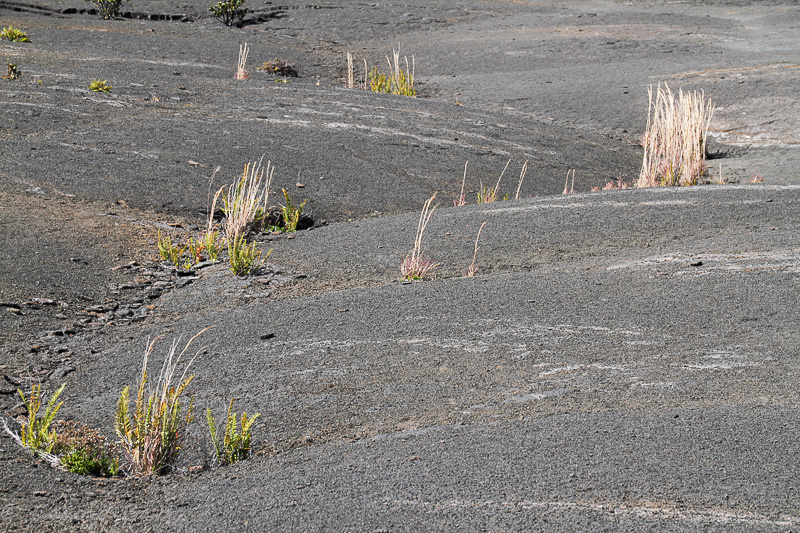
But the really fascinating thing is to see the way nature recovers. There are 'Ōhi'a trees growing out of nothing, seemingly effortless. I saw ferns seeking their way to the light through the tiniest opening in the lava. In places where we don't see anything but black hardened lava, life breaks its way through. It is fascinating.
You can cross the crater in an hour if you're a good hiker. However, it took us more than two hours, since both the Geek and I stopped ever so often to take photos. I am so thankful that we share the same passion when it comes to photography. It would be agonizing if one of us didn't enjoy it.
Remember I said at the beginning of the hike you can see all over the crater to what seems like the end of it? Well, we're already past that "end" point. And it still goes on...
However, the landscapes changes and is getting rougher than the floor of the crater we passed through until here. We are much closer to the eruption center.
The Geek and I took our break here, eating granola bars and drinking water. We took our sweet time admiring (and photographing) this beautiful 'Ōhi'a lehua blossom.
Aren't they pretty?
Unfortunately there is a newly identified fungal disease called ROD - Rapid 'Ōhi'a Death. It attacks and kills 'Ōhi'a on the Big Island. The fungus clogs the tree's vascular system, depriving the canopy of water and may kill the tree very quickly. Since 'Ōhi'a is the keystone species in Hawaiian forests, ROD has the potential to cause major ecosystem disturbances. Fortunately, the 'Ōhi'a in the summit area - that includes Kīlauea Iki - are not yet infected with ROD.
Most of Kīlauea Iki crater consists of smooth lava called pāhoehoe. This lava flows rather slowly and forms a smooth surface or "ropey" shapes when it cools and hardens. It's easy to walk on. The other kind of lava, called a'ā, is rough and sharp. This is the lava we find at the end of the crater. It is not easy to walk on at all and a wrong step can be rather painful.
However, this is where we found quite some of Pele's hair. Remember, Pele is the Hawaiian goddess of volcanoes, but what's her hair? It's fine threads of volcanic glass. The strands are formed through the stretching of molten basaltic glass from lava. It is extremely light.
We're at the edge of the crater at the end. A last look back before we climb up to the rim, again through lush rain forest.
Here, the ascent is much steeper and the trail has many steps to make it easier. I'm glad that we chose this way to go, because my knees would not have liked to go down this trail. Yes, I was sweating and huffing and puffing, but I would do the entire hike again in a heartbeat .
And up from the rim we can see the fuming Halema'uma'u Crater of Kīlauea.
Subscribe to:
Posts (Atom)